
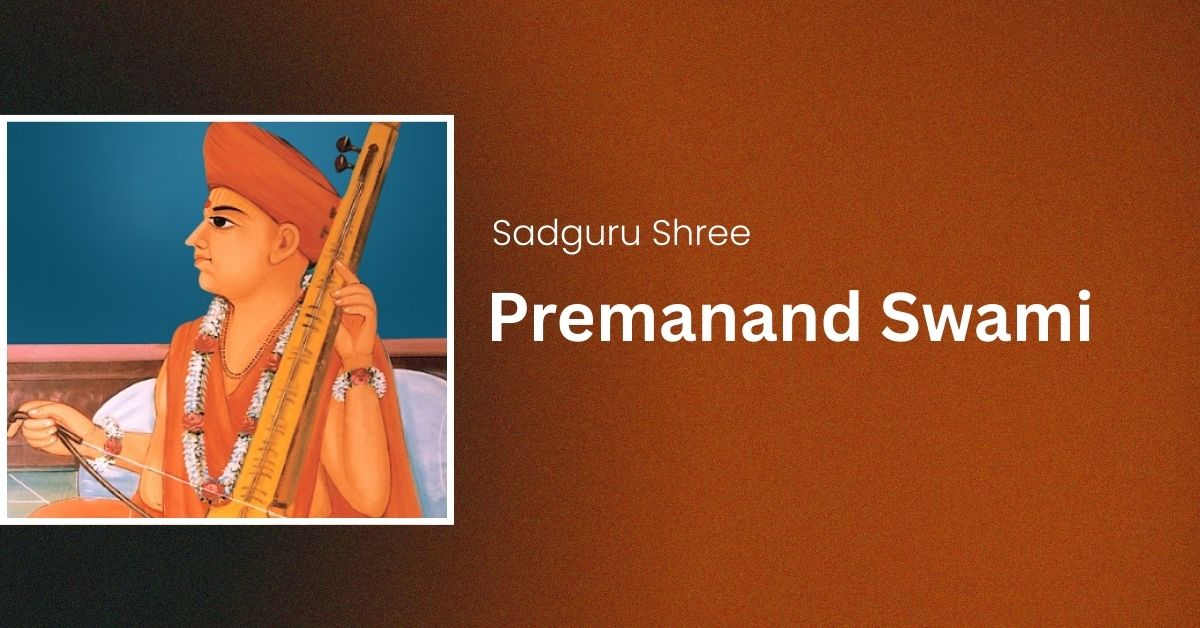

Sadguru Shree Premanand Swami was born in V.S. 1840 (C.E. 1784) in the village of Dora and returned to Akshardham in C.E. 1856 in Gadhada. He was a saint and a poet who wrote primarily in the Gujarati language. Honored with the title of the “Gopi” of the Swaminarayan Sampraday, the saint-poet Premanand Swami holds a unique and distinguished position among the eight eminent poets of the fellowship. He was born into a Brahmin family in Sevalia, near Khambhat.
His childhood name was Hathi. He was the son of Sevakray and Sunandadevi. Following his birth, he was abandoned by his parents and was subsequently raised by a noble Muslim gentleman named Dosabhai Tai. At a very young age, he first was introduced to Bhagwan Shree Swaminarayan in Jetpur and then later received diksha in Gadhada. His initial name was Nijbodhanand, but because it did not fit the meter of his poetic compositions, Bhagwan Shree Swaminarayan renamed him Premanand Swami. Bhagwan Shree Swaminarayan also gave him the affectionate nickname “Premsakhi,” which became his beloved pen name.
Premanand Swami was a master of divine love (Prem-bhav). Whenever he sang his poetry to the accompaniment of the sarangi, Bhagwan Shree Swaminarayan Himself would be so captivated that He would sit among the listeners to hear him. He composed a vast number of ras, pad, garba, and folk-style songs, as well as compositions based on classical ragas. His prolific body of work includes verses in Hindi, Vraj, Sanskrit, Marwari, Marathi, and Gujarati. Many of these verses express Prem-laxana Bhakti (devotion centered on intense love), sectarian teachings, and the wisdom of detachment (vairagya), as well as his deep affection for Bhagwan Shree Krishna and Bhagwan Shree Swaminarayan.
Among his well-known works are the Chesta pads, Tulsi-Vivah and Narayan-Charitra. They are all compiled within the Premanand Kavya. He returned to Akshardham in V.S. 1911 (C.E. 1856) in Gadhada, leaving behind a rich spiritual and literary legacy.