
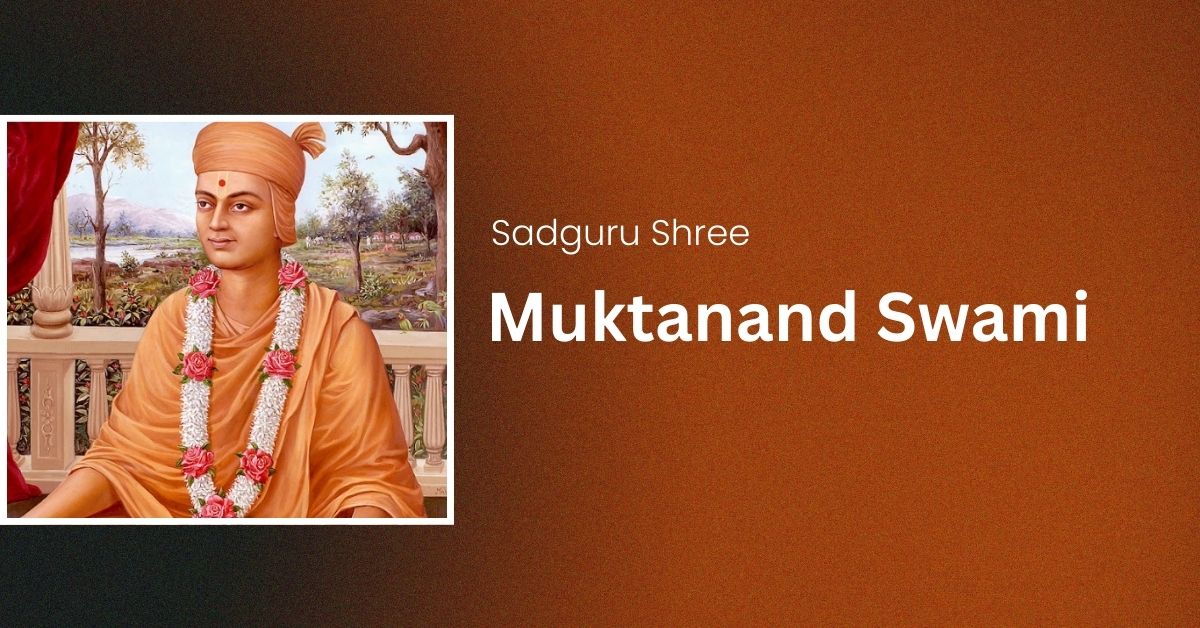

Muktanand Swami was born as Mukunddas on Posh Vad 7 V.S. 1814 in Amreli to Anandram and Radhadevi. Mukunddas received his early knowledge of Sanskrit and music from his father and studied Sanskrit, Gujarati, and the Vraj languages. He received formal training in poetics from the famous saint-poet Muldas and also achieved proficiency in the science of medicine (Vaidak Shastra). From a young age, he showed a natural inclination toward Satsang and detachment (vairagya). Possessing a very melodious voice, he would recite the Ramayan, Mahabharat, and other scriptures to the local community.
On the day of Vasant Panchami in Samvat 1842 (1786 C.E.), he received diksha into the Uddhav Sampraday from Ramanand Swami and was named Muktanand Swami. Due to his profound knowledge, scholarship, and dedication, he earned the position of Ramanand Swami’s principal disciple (pattashishya). In Samvat 1856 (1800 C.E.), when Bhagwan Shree Swaminarayan arrived in Loj in the guise of Nilkanth Varni, He was so impressed by Muktanand Swami’s wisdom and detachment that He decided to make Gujarat His permanent residence.
As the principal disciple of Ramanand Swami, Muktanand Swami was the natural successor to the Uddhav Sampraday. However, when Ramanand Swami appointed Bhagwan Shree Swaminarayan as the successor, Muktanand Swami accepted Bhagwan Shree Swaminarayan—who was 23 years his junior—as his Guru without a trace of bitterness and remained devoted to Him throughout his life. Because of this monumental sacrifice and nurturing nature, he is honored as the “Mother of the Swaminarayan Sampraday.”
Among the five hundred paramhansas of Bhagwan Shree Swaminarayan, he was considered the “Mer” (the central bead of a rosary). He achieved a great victory in a scriptural debate (shastrarth) before the Gaekwad government of Vadodara, defeating numerous scholars. He was also an expert in dance; he possessed the unique skill of dancing on a white sheet covered in vermillion (gulal) and, using only his feet, painting the figure of an elephant on the cloth. Just one month after the departure of Bhagwan Shree Swaminarayan, Swammi left his physical body while in a state of deep meditation (samadhi) on Ashadh Vad 11 V.S. 1886 (1830 C.E.) in Gadhada.
His Literary Works:
- Dharmakhyan
- Panchratnam
- Vivek chintamani
- Uddhav Gita
- Satsang Shiromani
- Sati Gita
- Shikshapatri Bhasha
- Mukund Bavani
- Dhamvarnan Chaturi
- Vasudev Avatar charitram
- Avadhut gitam
- Guru Chovishi
- Krishna Prasad
- Narayan Charitram
- Narayan Kavacham
- Vaikunth dham darshanam
- Bhagavad Gita Bhasha
- Kapil Gita
- Gun vibhag
- Narayan Gita
- Rukmani Vivah
- Raslila
- Hanumat panchak
- Hanumat Namavali
- Satsangi jivan Mahatmya
In his compositions, depth of meaning (arth gambhirya) takes precedence over mere wordplay. Numerous research theses are have been written on his works; notably, the French scholar Francoise Mallison wrote a research thesis on his work Sati Gita. Research has also been conducted on the overall life and poetic journey of Muktanand Swami.