
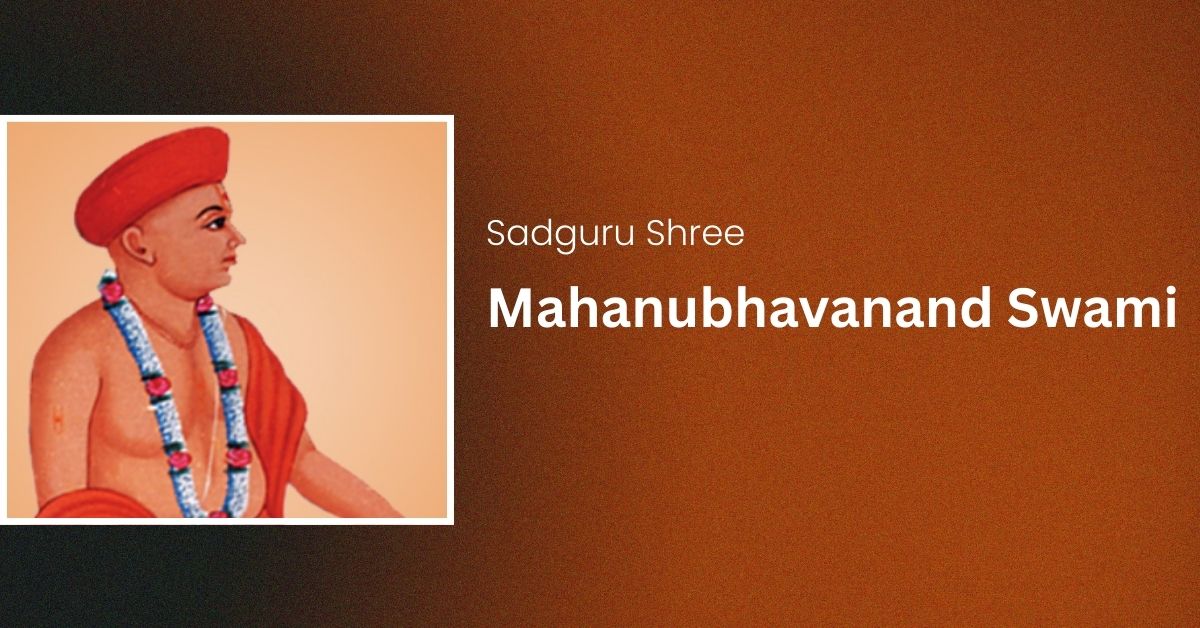

Sadguru Shree Mahanubhavanand Swami was a sadhu who possessed natural mastery over his words (vachan siddhi) and kept the divine form of Shreeji Maharaj constantly in his heart. Despite his high spiritual state, he traveled through every village of the Ahmedabad region, rendering immense service to the growth of the Satsang. He was from the village “Kada,” located about 125 gaus (250 miles) from Kurukshetra. From his teenage years, a strong wave of detachment (vairagya) took hold of him; consequently, he renounced his home. During his travels to various holy sites, he met and stayed with an elderly Mahatma who had renounced both women and wealth. When that Mahatma proposed making him the head (Mahant) of the establishment, he left under the pretext of going on a pilgrimage to Dwarka. In Dwarka, he took a vow of twelve years of continuous worship. However, on the fourth day, Lord Dwarkadhish appeared to him in a vision and said, “Leave this place; you will meet the manifest Purna Purushottam Narayan.”
Obeying the command of Dwarkadhish, he boarded a ship and landed at Jamnagar, where he encountered Swarupanand Swami. When Swarupanand Swami spoke of the manifest divinity of Bhagwan Shree Swaminarayan, he replied in a bold voice, “I am a worshiper of Krishna; I shall not seek refuge elsewhere (anyashray).” Despite this initial hesitation, he traveled to the festival (samaiyo) at Siddhpur for darshan. There, he renounced all other refuges and became an ardent follower of Bhagwan Shree Swaminarayan. When this renunciant, captivated by the sight of Maharaj in Unjha, surrendered himself, Bhagwan Shree Swaminarayan gave him diksha and gave him the name “Mahanubhavanand Swami.”
Mahanubhavanand Swami recognized Maharaj as the manifest Lord at first sight, and Maharaj also took note of his high spiritual state. After attending the festival in Siddhpur and coming to Vadtal, Maharaj bestowed upon him the status of “Sadguru.” Mahanubhavanand Swami was a man of perfected speech; whatever he uttered came to pass. He oversaw the construction of mandirs in many villages and never hesitated to correct those who maliciously obstructed the growth of the Satsang. Once, when Swami visited Mansa, the local ruler (Thakor Saheb) came for darshan. When Swami requested space to resolve the lack of facilities for the sadhus’ storehouse (bhandar), the minister (Diwan) interrupted, hoping for a reward from the ruler. The minister said, “You will have to take the temple elsewhere; we intend to build a stable (ghodshala) on that spot.” Hearing this, Swami immediately replied with his ‘reward’: “A stable? A stable shall be in your home!”
Just a few days later, the minister was found guilty of a crime, and the ruler expelled him from the kingdom with only the clothes on his back. The place where the minister used to live was subsequently converted into a stable. Many such incidents, testifying to his spirit of service and the power of his words, are still sung within the Sampraday.