
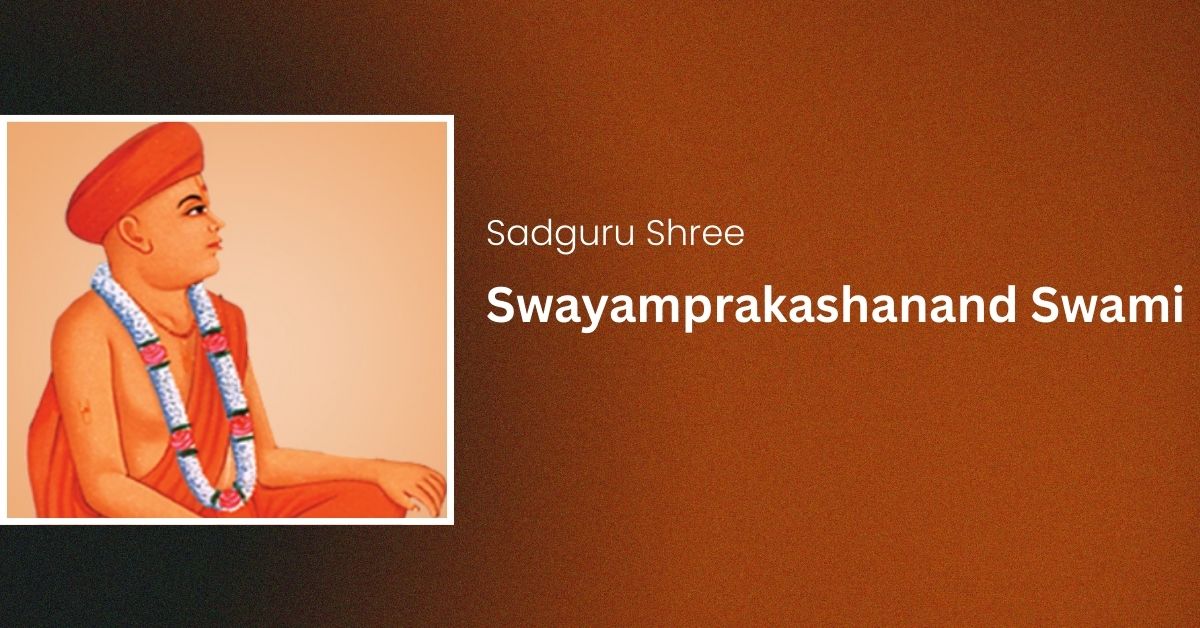

Sadguru Shree Swayamprakashanand Swami was a sadhu who abandoned the allure of prestige and position. Decorating his vast scholarship with the virtue of humility, he lived a saga of servitude and became a perpetual traveler on the eternal path of spirituality. Rejecting immense wealth as if it were mere grass, his life shone like a brilliant star within the group of the five hundred paramhansas.
Originally, he was the head (Mahant) of a large renunciant establishment near Calcutta in Bengal. Two hundred vairagis resided in that ashram. One day, a traveling renunciant arrived and began sharing various stories. He spoke of a “Liberator of Souls” who had manifested in Saurashtra, who was said to be the manifest Bhagwan Himself, capable of granting samadhi and sending people to the divine abode. As he spoke, an intense divine light began to radiate in that place. The Mahant went outside to investigate the source of such light at night, but upon returning to the room, he saw the light just as before. As long as the visitor continued his discourse, the mass of light remained. The Mahant thought, “If merely talking about Him causes an inexhaustible ocean of divine majesty to surge, how much power must He truly possess? He must surely be Bhagwan.” The seeds of devotion began to sprout in the fertile soil of his heart, and a firm faith in Bhagwan Shree Swaminarayan was established. Driven by true seeker-ship (mumukshuta), he developed an intense longing for the darshan of the manifest Purushottam Narayan.
A few days later, under the pretext of a pilgrimage to Dwarka, the Mahant departed with a few disciples, horses, and camels. While traveling through various holy sites, they reached Loj to receive food from the sadavrat of Bhagwan Shree Swaminarayan. The moment the image of Maharaj touched his heart, the Mahant entered a state of samadhi. In that trance, he beheld Maharaj presiding in Akshardham, and the beautiful form of Maharaj became permanently etched upon his memory. Upon awakening, witnessing the divine glory of Maharaj, the Mahant handed over the deed to his position, three thousand gold coins, his gold necklaces, and rosaries to his younger guru bhai.
He then offered dandvat (prostrations) and humbly said to Maharaj, “Grant me the service of Your lotus feet and make me Your own.” Bhagwan Shree Swaminarayan replied, “You will have to live according to Our commands and renounce wealth and women (kanak-kamini).” The Mahant agreed. Maharaj then gave him diksha and named him “Swayamprakashanand.” Since he was older than Maharaj, Maharaj addressed him as “Bhai” (Brother). Thus, in the Satsang, he was also known as Bhai Swayamprakashanand. There were sixty sadhus in his group (mandal), and because he was a great scholar, many younger sadhus resided with him.
He scaled the high peaks of spirituality and remained engrossed in the divine form of God. The questions he asked in the Vachanamrut testify to his depth of knowledge. Maharaj Himself would praise his scholarship. Having spent his entire life obeying the commands of the Lord and wearing out his body like sandalwood through constant travel for the Satsang,