

The Request of Jivo Dhadhal
After celebrating the Rath Yatra festival in Gadhada in V.S. 1864 (1808 C.E.), Bhagwan Shree Swaminarayan traveled to the village of Kariyani to bless the local devotees. He stayed at the royal court of Deha Khachar. Among the devotees was a man named Kalo Makwana, who earnestly prayed to Shree Hari to visit his humble home. Being “Bhaktavatsal” (the lover of His devotees), Shree Hari agreed.
In the gathering at Kalo’s house was a devotee named Jivo Dhadhal. Jivo was an expert flute player, a skill unmatched by others. He played the flute so beautifully that Shree Hari began to sway in joy, much like a cobra sways to music. Pleased, Shree Hari offered him a boon.
Jivo Dhadhal made a unique request: “O Shree Hari! In your previous incarnation as Krishna, You played the flute in the forests of Gokul and Vrindavan. I wish to see that same divine ‘Lila’ (episode) again today.” He then gifted Shree Hari a fresh, new flute.
Bliss at the Kalubhar River
As evening fell, Jivo Dhadhal suggested they go to the Vansavadi bank of the Kalubhar River. It was raining lightly, and Shree Hari worried about their clothes getting wet. Jivo quickly brought thick woolen blankets (Dhablo) for everyone. Clad in these blankets, they reached the riverbank.
Suddenly, the rain stopped, and a brilliant full moon rose in the sky. Shree Hari stood in His famous Tribhangi pose (bent at three points—knees, waist, and neck) and placed the flute to His lips.
As He began to play, the music was not of this world. He played the tunes of the Sama Veda. The effect was cosmic:
- The devtas arrived in their celestial vehicles to listen.
- The flowing waters of the river stood still.
- The wind stopped blowing, and the stars and moon remained fixed in the sky.
- Cows from nearby pens ran toward the music and surrounded Shree Hari.
The devotees entered a state of Samadhi (divine trance). In their trance, the Kalubhar River transformed into the Yamuna, and they saw themselves in the heart of Vrindavan. When they returned to consciousness, they realized hours had passed, though it felt like mere minutes.
The Room of the “Restless Ancestors”
The next day, while at Kalo Makwana’s house, Shree Hari noticed a room that was always kept locked. Kalo explained, “Maharaj, our ancestors who died with unfulfilled worldly desires are trapped there as ghosts. We have made wooden idols (Phala) representing them. Whenever they are displeased, people get sick, and we have to call exorcists to beat drums and perform rituals. They are ‘living’ ghosts who trouble us when You are not here.”
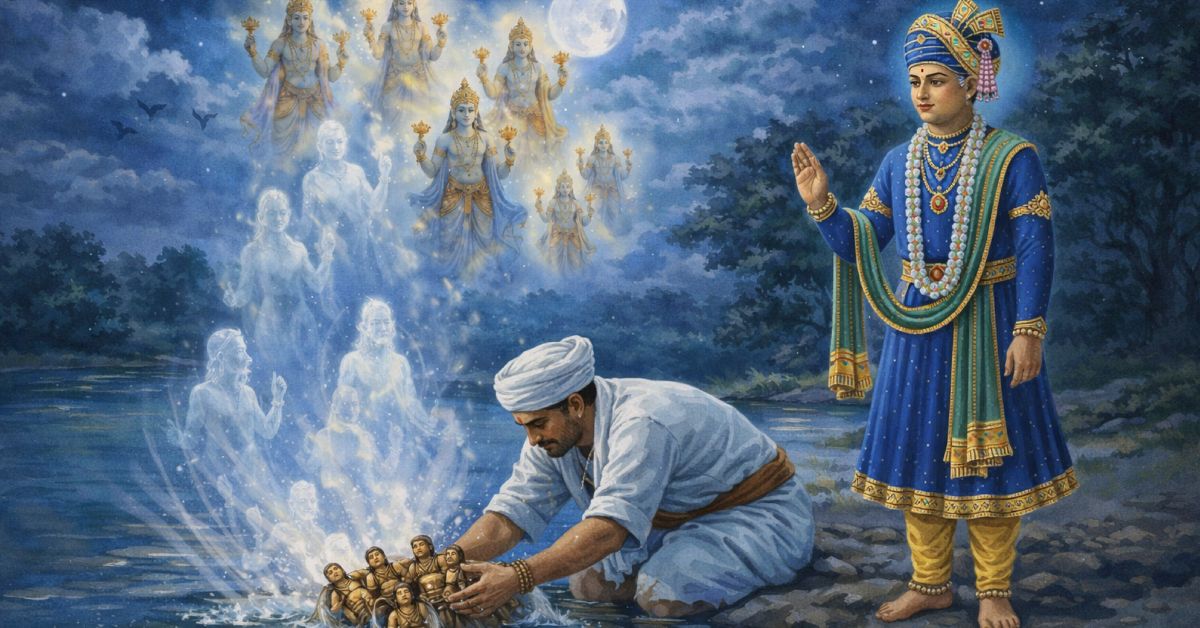
Shree Hari smiled and had the room opened. He saw many wooden idols, some with silver eyes. He ordered Kalo to tie them all in a bundle and bring them to the river.
Moksha at “Purvaj Ghat”
At the riverbank, Kalo’s wife, Vijalbai, offered Shree Hari roasted corn (makai) seasoned with spices. After enjoying the meal, they proceeded to the water.
Shree Hari told Kalo to submerge the bundle of idols in the river. As Kalo dipped them in, he had a vision: he saw the spirits of his ancestors crying out, “Water! Water!” Shree Hari explained that because they were in ghost bodies, the devta of water (Varun Dev) would not let them drink, leaving them eternally thirsty.
“Now,” Shree Hari commanded, “touch these idols to My feet.”
As soon as the wooden idols touched the divine feet of Bhagwan Shree Swaminarayan, the spirits were instantly liberated from their ghostly forms. They took four-armed divine bodies and ascended to the dham of Bhagwan. The devotees present were given divya drashti (divine sight) to witness this miraculous exodus of souls.
The Glory of the River
Shree Hari then proclaimed the greatness of the Kalubhar River at that spot, naming it Purvaj Ghat (The Bank of Ancestors). He declared:
- This spot is just as sacred as the Yamuna or the Ganga
- Anyone who bathes here will be cleansed of sins and reach the dham of Bhagwan
- Anyone who performs rituals for their ancestors (Shraddha or Tarpan) here will ensure their ancestors’ permanent moksha
This prasang has been documented by Acharya Shree Viharilalji Maharaj in Shree Harililamrut Kalash 6, Vishram 20.