
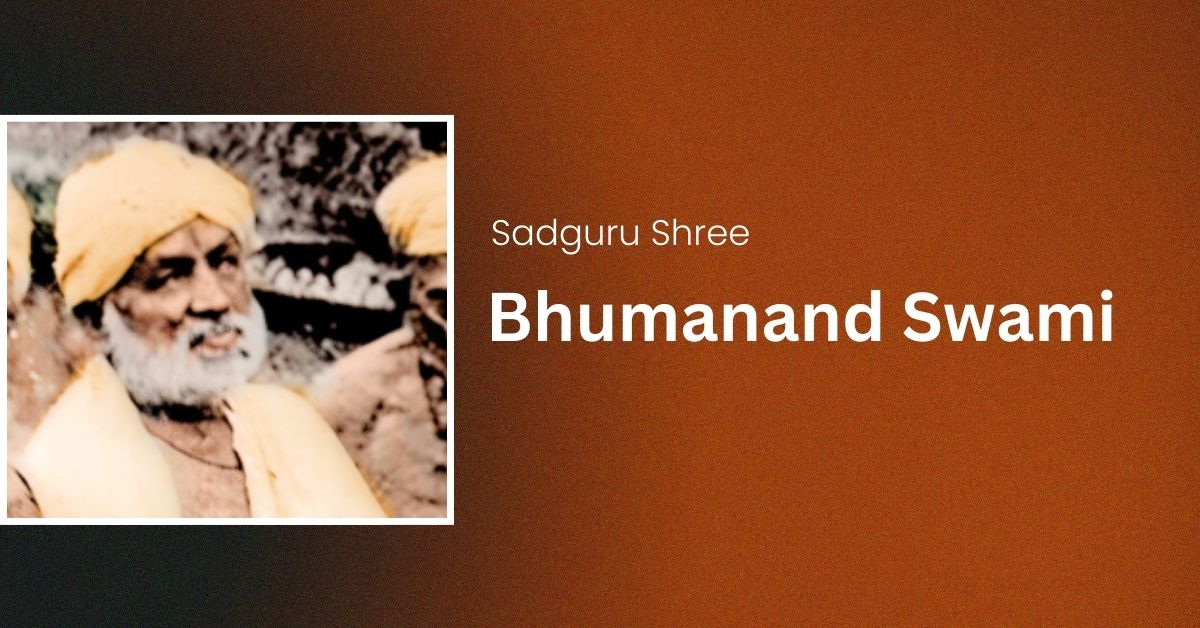

Bhumanand Swami was born in the village of Keshiya, near Bhadra in the Jodiya Taluka of Jamnagar district (Halar pradesh) on Vaishakh Sud 7 in Samvat 1852 (1796 C.E.). His father’s name was Ramjibhai and his mother’s name was Kunwarba. Born as Rupjibhai, he had three other brothers—Jivabhai, Ambabhai, and Panchabhai. From childhood, he possessed a virtuous (sattvic) nature and a natural inclination toward devotion and remembrance of God.
Once, a learned Brahmin came to Keshiya to recite the Mahabharat. At his father’s request, Rupjibhai went to listen. However, seeing men and women sitting together in a disorganized manner, he told his father, “What benefit is there in listening to such a discourse? It cannot remove the impurities of the mind.” Pleased by Rupjibhai’s noble thoughts, Ramjibhai said, “A new faith called ‘Swaminarayan’ has spread everywhere. It is a very pure and bright dharam.” The moment he heard the word “Swaminarayan,” it was as if a flash of lightning illuminated the dark clouds, spreading the light of divine knowledge and bliss within Rupjibhai’s heart.
After his father’s passing, fourteen-year-old Rupjibhai left Keshiya to work at a merchant’s shop in the village of Targhari. He worked for three years without asking for his wages. When he finally requested his pay, the merchant deceitfully claimed he had already paid him. To prove his false accusation, the merchant gathered the villagers and challenged the simple-natured Rupjibhai: “If you are truthful, wear this iron chain that has been heated in fire until it is glowing red around your neck.” At this moment, Rupjibhai remembered Bhagwan Shree Swaminarayan.
While remembering Bhagwan, he placed the red-hot chain around his neck. Thus, the deity of fire (Agnidev) protected him. The merchant’s deceit was exposed, the people rebuked him, and Rupjibhai received his money. He then left for Kutch for work, where he met Gangaram bhai. After six years in Kutch, he returned to the village of Kharva near Wadhwan. There, he met Dhanraba, a devotee of Bhagwan Shree Swaminarayan. Once, Dhanraba took him to a festival (samaiya) in Gadhpur. On the way, Rupjibhai took a sankalp: “If I meet the Lord on the path with pomp and music, I will accept Him as the one true God!” To fulfill this wish, Bhagwan Shree Swaminarayan, adorned in grand garments and ornaments and riding a horse, was traveling from Dada Khachar’s darbar to Laxmi Vadi at that very moment.
Rupjibhai gave poetic form to that vision and joyfully sang: “Sarve sakhi jivan jovane chalo re” (Come, all friends, let us go to behold the Life of our souls). As the hymn ended, he tearfully bowed down to lotus feet of Shreeji Maharaj. Right there, in Laxmi Vadi, he was given diksha and named Bhudaranand Swami. However, since his name did not fit the meter at the end of his kirtans, he was renamed Bhumanand Swami. Swami possessed extraordinary poetic and oratorical skills, composing many kirtans describing the divine form and glory of Bhagwan Shree Swaminarayan.
Once, while traveling through villages to spread satsang, Bhumanand Swami went without food for four days. Thirst and hunger began to trouble him, and his throat grew parched. On the fifth day, having obtained some roasted green wheat (ponk), he meditated on Maharaj and lovingly offered thaal. While singing “Jamo thal jivan jau vari,” Bhagwan Shree Swaminarayan manifested physically and began eating the items mentioned in the thaal, granting darshan to Swami.
In Samvat 1890 (1834 C.E.), during the Vasant Panchami Rangotsav in Muli, the famous poet Dalpatram met Bhumanand Swami and heard his divine words. Swami’s piercing words struck Dalpatram’s heart like an arrow. With tears in his eyes, he accepted the panch vartaman and became a follower of the Satsang. He also translated several works in the Vraj language, including the Vasudev Mahatmya, Shreemad Bhagwat Pancham Skandh, and Shreemad Bhagwat Dasham Skandh. Bhumanand Swami also composed the Shree Ghanshyam Lilamrut Sagar.
When the time came to depart Earth, he personally prepared a symbolic divine chariot (viman) in the village of Mansa, sat in it, and announced, “I shall depart for Akshardham after noon.” On the Sunday of Maha Vad 8 in Samvat 1924 (1868 C.E), he left his physical body and returned to Akshardham.