

The Journey to Jetalpur
After traveling through various villages with a group of santo, Bhagwan Shree Swaminarayan arrived in Jetalpur. He took up residence at a palace on the banks of the village lake. Looking at the serene environment, Maharaj decided it was the perfect place for his santo and Brahmins to engage in deep study. He commanded them to begin studying Sanskrit, and obeying his wish, they immediately dedicated themselves to their education.
The Decision for a Grand Festival
The next day, while sitting under a large Banyan tree, Shree Hari was surrounded by devoted followers like Gangadas, Bhikharidas, and Asharam Travadi. When Maharaj mentioned he planned to move on to the next village, Gangama pleaded with him to stay. “Tomorrow is the holy day of Uttarayan (Makar Sankranti),” she said. “Please stay and celebrate the festival here.”
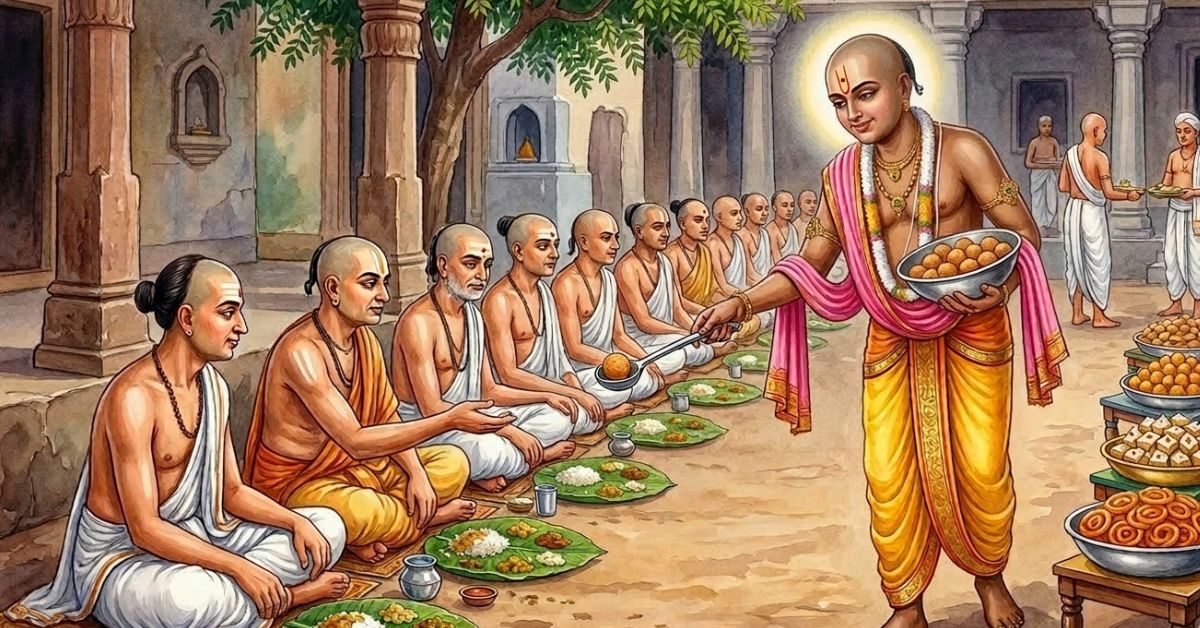
Shree Hari agreed but decided to turn the simple festival into something historic. He asked the devotees, “If we were to perform a Chorashi (a feast for all local Brahmins), how much ghee would be required?” The devotees estimated five maunds (~400 lbs). Maharaj then asked, “What if we invite Brahmins from all the surrounding villages? What if we invite those from Ahmedabad?”
The devotees realized the scale was growing beyond their imagination. Maharaj then commanded, “Send letters everywhere. Invite every Brahmin and every devotee. Bring mountains of food, sugar, and ghee!”
Divine Abundance
As the supplies began to arrive, Shree Hari looked at the massive piles of grains and provisions. He commanded the Eight Siddhis (divine powers) to reside in the storehouse, ensuring that no matter how much was used to feed the thousands of guests, the piles would never diminish.
Seeing the devotion of devotees such as Asharam Travadi, Maharaj announced, “We shall not just have a feast; we shall perform a Maha-Rudra Yagna.” He sent invitations as far as Kashi to bring the most learned Vedic scholars. Devotees from Kutch, Kathiawad, and the rest of Gujarat along with Khandesh (Maharashtra + Madhya Pradesh) began pouring into Jetalpur like rivers flowing into the ocean.
Overcoming Obstacles
The Yagna began on Uttarayan and was set to last eighteen days. However, not everyone was happy. Some people, filled with jealousy toward the growing Swaminarayan Sampraday, attempted to sabotage the event.
Under the cover of the crowd, these detractors began throwing laddoos into the lake to create a shortage. Others carried sticks, hoping to start a brawl and disrupt the sacred atmosphere. One person even shouted a false alarm: “The ghee has run out! Stop the cooking!”
Shree Hari, forever omnipresent, remained calm. He walked to the kitchens with twenty-five of his personal guards (Parshads). He caught the troublemakers red-handed and saw the wasted food in the water. He quietly removed the ill-intentioned people from the kitchen and replaced them with his own devoted followers to serve the food. He then showed the skeptics the massive vats of ghee, which—by his divine grace—remained full despite the thousands being fed.
The Glory of the Brahmins
The Yagna concluded with a grand ceremony (Purnahuti). After the final offerings were made into the sacred fire, Shree Hari sat before the sabha and delivered a profound message on the importance of Brahmins and Dharma:
“The Brahmins are the vessels of my own words,” Maharaj declared. “They and the santo are the two protectors of Dharma. Without the Brahmins, the wisdom of the Vedas would have perished. They perform the Yagnas that please the Divine and guide society toward Bhagwan.”
He emphasized that those who honor Brahmins honor Him, and those who insult them insult Him. However, He also gave a stern warning: a Brahmin who abandons virtues and follows a sinful path falls from the very doorstep of moksha. He urged his followers to maintain their daily rituals (Sandhya) and the chanting of the Gayatri Mantra.
The Jetalpur Yagna became a legendary event, proving Shree Hari’s divinity through the miracle of the inexhaustible food stores and his profound respect for Vedic traditions. This event has been documented by Acharya Shree Viharilalji Maharaj in Harililamrut Kalash 7, Vishram 2.