
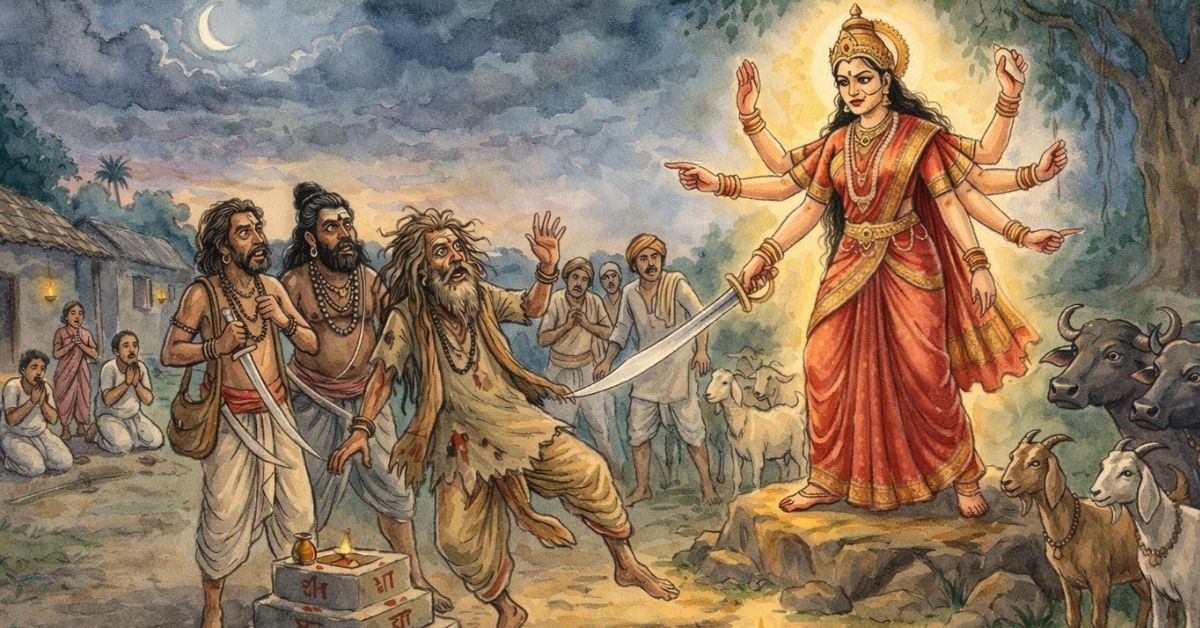

The village of Chhapaiya and its neighbors were once gripped by a terrifying cholera plague. People were dying in such numbers that the village was filled with grief. In their desperation, some villagers turned to superstitious rituals. A group of men, driven by fear and corrupted logic, decided that the only way to stop the disease was to offer violent sacrifices to the Goddess Bhavani. They gathered goats and buffaloes and marched to the temple east of Narayan Sarovar.
As the shamans danced in trances and demanded blood, the men drew their swords. But before they could strike, Bhavani Devi manifested her fierce form, moving in perfect alignment with the divine sankalp (resolve) of young Ghanshyam. She snatched their swords and rebuked them. “You fools!” she cried. “Do you think killing innocent animals will cure a disease? This plague is the will of Bhagwan.”
She continued, “I am a Goddess of Purity, yet you offer me the worship of the corrupt? Bhagwan loves non-violence, but your wisdom has been lost to madness. This is not the path of the scriptures. Listen well: if you oppose my will, you will fall long before any plague can take you. I will become your death; my sword will find your necks. Why do you strive to make me a demon by performing such cruelty in my presence?”
She then revealed a great truth: that Purushottam Narayan had manifested in the house of Dharmadev and Bhaktimata as Ghanshyam. She told the shamans to drop their weapons and seek His shelter. The terrified villagers rushed to Ghanshyam’s house. Ghanshyam, in His infinite mercy, promised that as long as He resided in Chhapaiya, the disease would not enter the village or the surrounding five yojans (~40 miles). He then commanded the deities of cholera to leave the righteous people alone and only visit those who were demonic in nature. Filled with gratitude, the villagers invited Ghanshyam to their homes. Ghanshyam took multiple forms and ate at every household simultaneously, filling the village with divine joy.
This prasang has been documented by Sadguru Shree Bhumanand Swami in the 33rd Tarang of Shree Ghanshyam Lilamrut Sagar.