
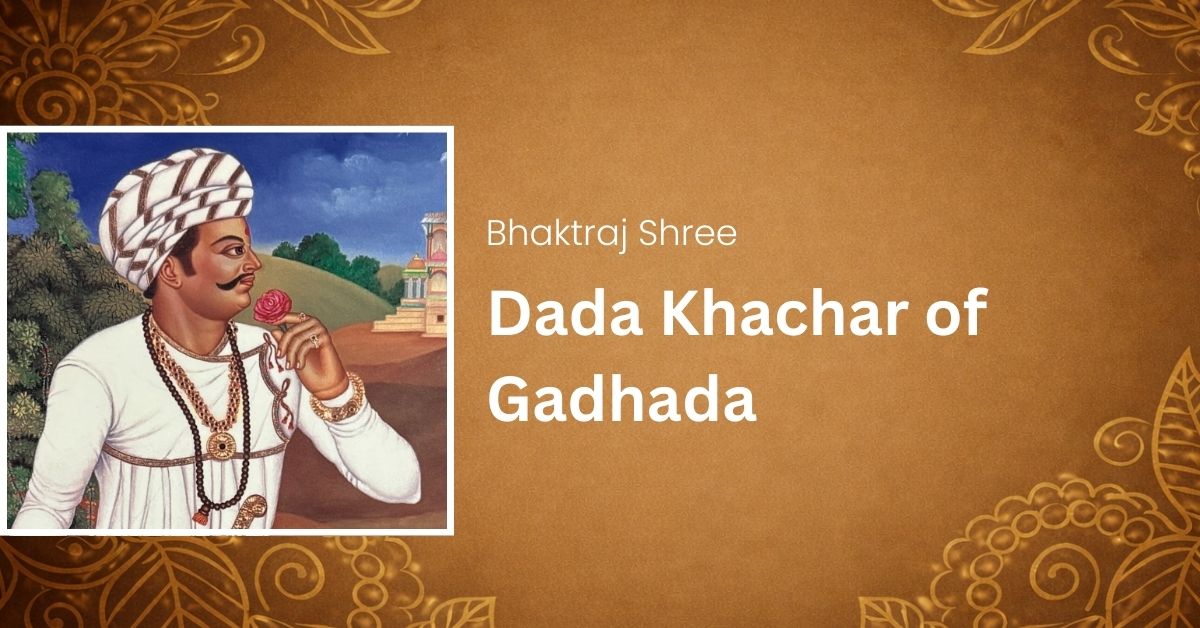

Among the exceptionally loyal householder devotees in the history of the Shree Swaminarayan Sampraday—those who became the foundational pillars of development by dedicating their body, mind, and wealth—the most ideal and uniquely charismatic personality is Bhaktraj Shree Dada Khachar.
Shree Dada Khachar was the only son and heir of Darbar Shree Ebhal Bapu of Gadhpur. Although Dada Khachar was born in Botad, Gadhpur was his karma bhumi (land of action). Bor on Posh Vad 6 V.S. 1857, his formal name was “Uttam,” but everyone affectionately called him “Dada.”
In V.S. 1861 (1805 C.E.), after celebrating Vasantotsav in Kariyani, Bhagwan Shree Swaminarayan arrived in Gadhada. Ebhal Bapu’s family not only extended a grand welcome to Him but also surrendered their home and belongings, accepting a life of seva. Maharaj also accepted Gadhada as His own personal residence.
Dada Khachar’s childhood was spent right in front of Maharaj. He was only five years old when Maharaj came to Gadhpur, yet his bhakti surpassed that of anyone else. Consequently, his name resonated as a premier devotee of Maharaj not only among the sampraday but even within the offices of the British Governor. Dada Khachar was such a devotee that Maharaj Himself took on the role of an elder to guide him in his education, worldly affairs, and spirituality.
Dada Khachar was a staunchly loyal and trustworthy devotee who emerged refined after passing multiple trials by fire. If Maharaj asked him to try and fit a large gourd into a small earthen pot, he would sit down to do it immediately; if Maharaj called for him, he would present himself even if he was only halfway through a shave.
His first wife was Kumudba. Since Dada had no children with her, Maharaj Himself insisted and arranged a second marriage with “Jashuba,” the daughter of Nagpal Varu of Bhatvadar. This event remains one of a kind in the history of the Sampraday, as Maharaj Himself became the charioteer for Dada Khachar’s wedding procession, and even those who had renounced the company of women joined the procession as guests. This goes to show as a testament to Dada Khachar’s unwavering faith in Maharaj.
Dada Khachar was as proficient in worldly affairs as he was in his devotion. According to references in the History of Gujarat, he acted as a mediator to arrange negotiations between Jogidas Khuman, who had revolted against Bhavnagar, and Maharaja Shree Vajesinh. At the young age of 28, Dada Khachar initiated an era of peace in the History of Kathiawad. He skillfully resolved an old royal family conflict, a resolution that was even recognized by the Bombay Government. In short, despite being an ideal ruler, Dada Khachar lived his life as a servant of servants and was a beloved devotee of Maharaj. Following his second marriage, he had two sons, Bawa Khachar and Amra Khachar.
When Maharaj performed the pratishtha of Gopinathji Maharaj on Aso Sud 12, V.S. 1885 (1829 C.E.), Dada offered 200 acres of his land to the mandir, which is known today as “Radha Vadi.” This Bhaktaraj had cultivated an inseparable bond with Maharaj. Overwhelmed by the grief of Maharaj’s departure, he was ready to cast himself onto the funeral pyre. Even when Gopalanand Swami tried to console him, he found no peace until Maharaj personally manifested and placed a rose garland around his neck. Thereafter, living with the serene peace and total surrender as an Atmanivedi devotee, he discarded his physical body in Gadhpur in V.S.1909 (1853 C.E.) and returned to Akshardham.