
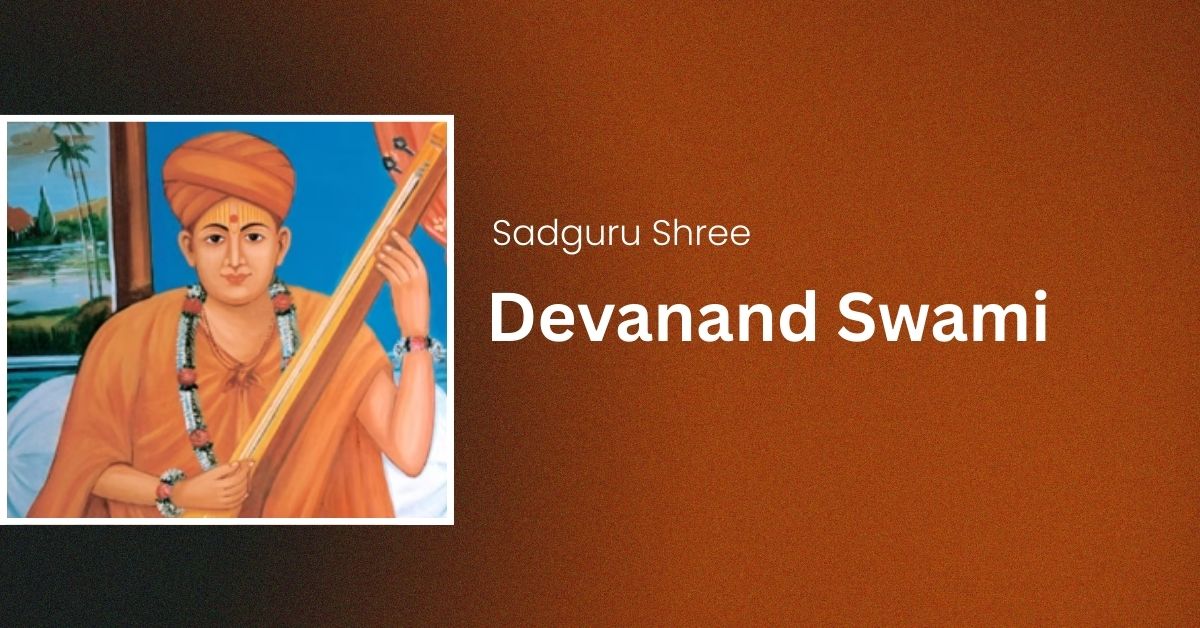

Born as Devidan Charan in the village of Balol, near Dholka, on Kartik Purnima, V.S. 1859 (1802 C.E.), Devanand Swami was destined for a life of profound devotion. His father, Jijabhai, and mother, Bahenjiba, were devotees of Lord Shiva. From a young age, Devidan was immersed in the spirituality of his family and was particularly drawn to Lord Shiva, displaying a deep spiritual inclination similar to Prahlad. It is said that he had a direct vision of Lord Shiva, who told him that the Supreme Being, Sahajanand Swami, was on Earth and would come to him. Lord Shiva also gave him a unique sign for identification: the supreme being would be able to touch his own elbow with his tongue.
Devidan’s wait ended when Bhagwan Shree Swaminarayan visited his village following the grand yagna in Jetalpur. During a meal, some milk dripped from the Shreeji Maharaj’s bowl onto his elbow, and He proceeded to lick it with his tongue. Recognizing this divine sign, Devidan immediately fell at his feet and was accepted as a disciple.
After his initiation into the Swaminarayan Sampraday, he was given the name Devanand Swami. He is considered one of the eight prominent poets (Ashta Kavis) of the Sampraday. He became a disciple of Brahmanand Swami, who was his guru in poetry and music. Devanand Swami’s poetic and musical talents were well-known; he showcased them during the murti pratishtha Shree Narnarayan Dev in Ahmedabad and even won a music competition against the royal singers of the Dharampur state.
Following Brahmanand Swami’s Earthly departure, Devanand Swami took over as the head (Mahant) of Swaminarayan Mandir Muli, a position he held for 22 years. His compositions are deeply spiritual and instructive, reflecting the futility of worldly life and the importance of devotion. His poetry, collected in the work “Devanand Kavya,” continues to be sung with great fervor in Swaminarayan temples and by devotees today.
Devanand Swami’s legacy also includes his role as the literary guru of the famous Gujarati poet Dalpatram, demonstrating his significant influence on Gujarati literature. He left his Earthly body on Shravan Vad 10, V.S. 1910 (1854 C.E.), in Muli, leaving behind a rich collection of spiritual works and a life dedicated to Shreeji Maharaj and the Swaminarayan Sampraday.