
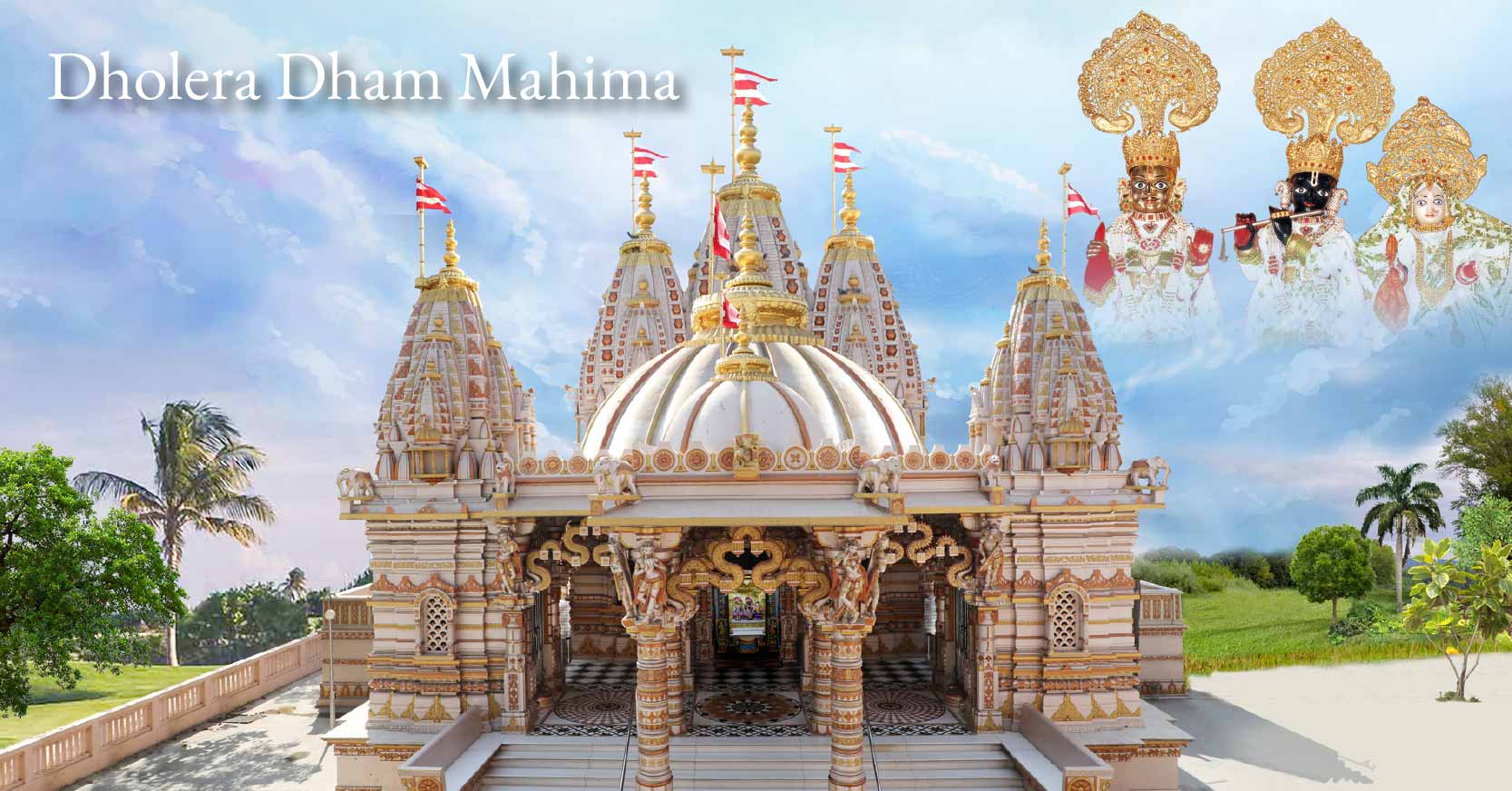

Among the six mandirs established by Bhagwan Shree Swaminarayan, the center of faith for the devotees of the Bhal region and a wonderful vision of the art and devotion to Shreeji Maharaj built by Vairagya Murti Sadguru Shree Nishkulanand Swami, is Shree Swaminarayan Temple, Dholera.
Bhagwan Shree Swaminarayan performed the foundation stone laying ceremony (Khat-muhurt) with His own hands. Shreeji Maharaj commanded five saints—Adbhutanand Swami, Nishkulanand Swami, Shree Bhai Atmanand Swami, Shree Nishkamanand Swami, and Shree Tyaganand Swami—to construct the temple. With the cooperation of all the santo, Shree Nishkulanand Swami applied the wonderful art contained within himself to this temple construction project. The temple, including five pinnacles (shikhars) with artistic carvings, was prepared within a short time.
Dholera Dham is a result of Shreeji Maharaj’s sankalp; Dholera Dham is also a result of Shree Nishkulanand Swami’s art and devotion to Shreeji Maharaj. Describing the mahima of this mandir, Shreeji Maharaj Himself says:
Mate mare e mandir par, ghanu ghanu rahe chhe het;
For this reason I have much love for this [Dholera] Mandir
Dhanya dhanya eh santne, je iyan rahe kari prit.
Many thanks to that sant who lives here with love and devotion.
Seeing the eye-catching artistic carvings of this temple, expressing the joy of Shreeji Maharaj, Acharya Shree Viharilalji Maharaj writes in the ‘Shree Harililamrut’:
Jova mandir Shree Maharaj, gaya le sathe mitrasamaj;
To see the Mandir, Shriji Maharaj went with an entourage of santo
Zhali Adbhutanandno hath, farya mandirma Muninath.
Taking Adbhutanand Swami’s hand in his hand, they walked the Mandir together.
Adbhutanand Nishkulanand, teh pratye bolya Jagvand;
He whom the whole world bows to said to Adbhutanand Swami and Nishkulanand Swami
Thayu mandir to bahu saru, joi raji thayu man maru.
The mandir is made very great, and I am very delighted at seeing it.
(Shree Harililamrut: 8/49)
The construction of this mandir is a saga of the seva, sharanagati, and the prem of devotees like Punjabhai, Bhojabhai, Bapujibhai, Varahabhai, Dosa Sheth, Gagjibhai, Kanjibhai, as well as Ajuba, Fuliba, and others.
On Friday, May 19, 1826 (Samvat 1882, Vaishakh Sud 13), Bhagwan Shree Swaminarayan, with His own auspicious hands, performed the murti pran-pratishtha of the murti of Shree Madanmohanji Maharaj in this mandir to fulfill all the desires of the devotees of the Bhal region ‘for as long as the sun and moon exist’ (surya chandra tape tya sudhi).
Note: Due to the devastating earthquake of 2001 C.E., some parts including the shikhars of the mandirs established by Shreeji Maharaj were severely damaged. The renovation of the original temple was carried out in Bansipahadpur stone with intricate carvings and artistic manner under the guidance of the then-Kothari Swami of Dholera Dham.
Dholera – From a Historical Perspective:
After King Chandrachud of the Chudasama dynasty, his descendants received the first pargana (administrative unit) of 84 villages of Bhal. From here, the Chudasama, Sarvaiya, and Raymal branches of the dynasty separated. The heirs of the Sarvaiya branch settled near Amreli and the Raymal branch settled in Dhandhuka. In 1721 C.E., Merakhji, Sujaji, and Bhanji, who were third generation descendants in the Chudasama lineage, established the throne in Dholera. Merakhji had Mebakji, who had Keshabha, who had Buttobha. Buttobha had two sons, Banesang and Punjabhai. Hence, Punjabhai became the heir to the Dholera throne.
A key attraction of Dholera is the ‘Pataliyo’ waterfall. When the British excavated 700 feet to extract minerals from the ground, they found a waterfall of hot sulfurous water. Again, a second 1800-foot excavation was made, and still, a flow of hot water was found. It is said that bathing in this water has cured skin diseases.
Background of Temple Construction
The darbar of Punja Bapu had nine villages under them: Dholera, Khun, Mahadevpuru, Bhangadh, Navu Gam, Ratvav, Bhimtalao, Mundi, and Zhankhi. Punja Bapu’s sister Ajuba was also a dedicated devotee of Shreeji Maharaj. Also, his uncle’s daughter Fuliba had immense devotion towards Shreeji Maharaj. Fuliba got married in Karamad. Submitting to her devotion, Bhagwan Shree Swaminarayan celebrated an Annakut festival in Karamad. (This is described in detail in Shree Harililamrut scripture, Kalash 8, Vishram 53 & 54) .
What we know as Dholera was once a small kingdom named ‘Dholpur’ about 400 years ago. Dholera is at the confluence of seven rivers.
Bhagya jagadva bhalna, dholere bandhie dham; Tema besarie murti, ati shobhit sundar shyam.
To awaken the fortune of the Bhaal region, we will build a mandir at Dholera, and we will place the murti there of Bhagwan
Eh bandar sundar saru re, jiya ave chhe lok hazaru re; Tiya mandir karvu ek re, saru sahuthi vali vashek re.
That beautiful port city where thousands of people come, there we want to build a mandir which is great and unique.
Em Nathe kari nirdhar re, puchhyu Punjabhaine te var re; Suno punyavan Punjabhai re, karie mandir Dholeramai re.
Thinking resolutely, Lord Shreei Hari asked the meritorious Punjabhai whether a mandir should be built in Dholera.
(Purushottam Prakash Prakar 34, Lines 4-6)
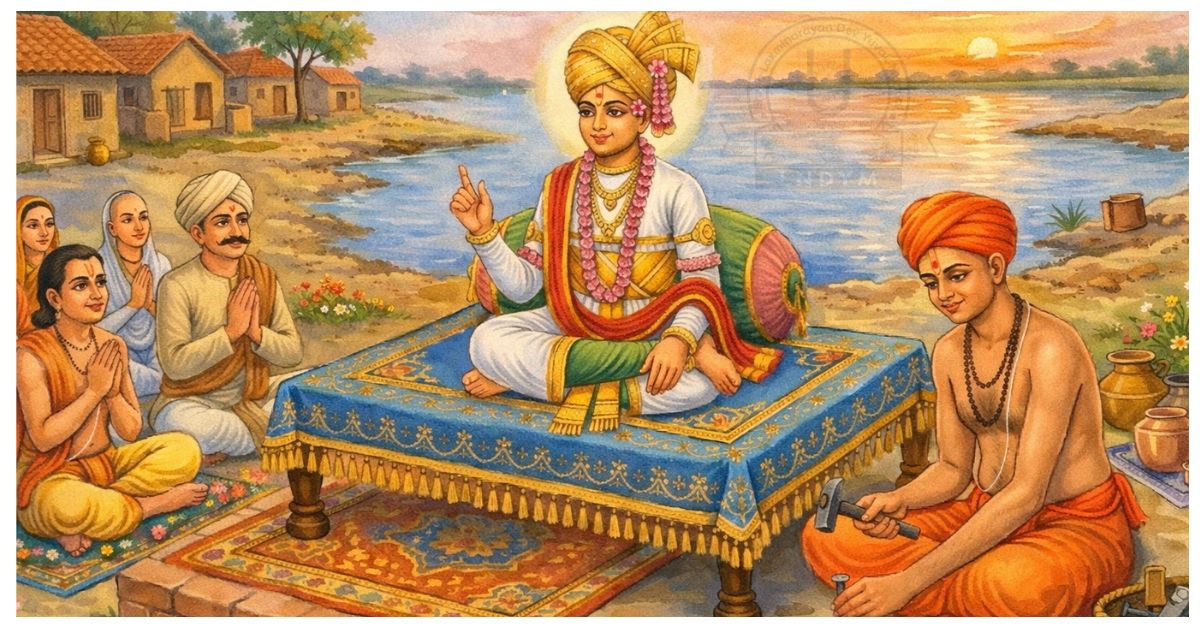
In Samvat 1881, after giving the joy of darshan and satsang to the devotees of Surat, Shreeji Maharaj arrived in Dholera via Bharuch, Khambhat, and Gudel. He ate the meal (thal) prepared by Ajuba and went to sleep. Then, in the third watch of the day (afternoon), Maharaj woke up, washed His face, drank water, and along with the santo and haribhakto, came to the bank of the lake and sat on a cot (dholiyo). At that time, seeing Shreeji Maharaj very pleased, Punja Bhai Darbar and other devotees requested Maharaj, saying: “O Maharaj! Please build a temple in Dholera, install a murti, and soak our dry Bhal region with the juice of devotion and Satsang”.
Hearing the feelings of the devotees, Maharaj said: “A temple should be built in such a way that the sinhassan comes at the place where our cot is”. Noting this, Sadguru Shree Nishkulanand Swami writes:
Pachhi Albele aganya kari, mandir karva mat; iya mandir karvu, jiya ame dhali chhe pat.
Then the Lord gave orders to build a mandir here, at the spot where his seat was strewn out.
Ati uttam chhe a bhumika, mota bhagyavali bharapur; Ochhu mahatmya anu nathi, jan mane janjyo jarur.
The Lord said, “this land is very great and full of much fortune. The importnace of it is not minute, and you people should know this truly.
Jiya besi ame jamiya, vali dhalyo dholiyo amulya; Juvo vichari jivma, kon ave a bhumine tulya.
Where I have sat, ate, and rested [here in Dholera], you [my devotees] should ponder in your minds what other land is in comparison to this land.
Mate mandir anhi arambho, ati ure ani anand; Thashe saras sahuthi, em boliya Sahajanand.
For this reason start building a mandir here bringing happiness in your heart. It will be the best of them all, said Sahajanand.”
(Purushottam Prakash: Prakar 35, Lines 1-4)
Hearing that, Nishkulanand Swami drove nails into the four places of the four legs of the cot to serve as a marker. (Currently, the sinhassan of Shree Madanmohanji Maharaj resides at this exact spot) .
Centuries ago, Dholera was a thriving port city. India’s culture flourished here. Hence, Bhagwan Shree Swaminarayan chose Dholera with great foresight. Firstly, Dholera was a center of ancient and prosperous India; secondly, it was at the central location of Gujarat and the Bhal region of Saurashtra. Shreeji Maharaj’s route from Gadhpur to Vadtal passed through the Bhal region thus he sanctified the entire Bhal region with His lotus feet.
Shreeji Maharaj commanded Nishkulanand Swami, saying: “Swami! You construct the temple in Dholera”. He also commanded Adbhutanand Swami, Atmanand Swami, Nishkamanand Swami, Tyaganand Swami, and other santo: “Santo! You go to Dholera to assist Nishkulanand Swami”. Upon receiving Shreeji Maharaj’s agyna, Nishkulanand Swami arrived in Dholera with a group of santo.
Constructing a temple in Dholera was not easy. Firstly, the dry land of Bhal, rain-dependent agriculture, salty water, and no special equipment or facilities were available. In the ‘Purushottam Prakash’, Sadguru Nishkulanand Swami has written:
Nano desh niras ati, dehabhimanine dukhurup;
This small/insignificant place without worldly enjoyments is a verified pain to those attached to their body.
Tiya tyagi hoy te take, bijane sankatrup. (Prakar 36, Line 3)
Only those with renunciation can last there, while it is a true trouble to others [those without renunciation].
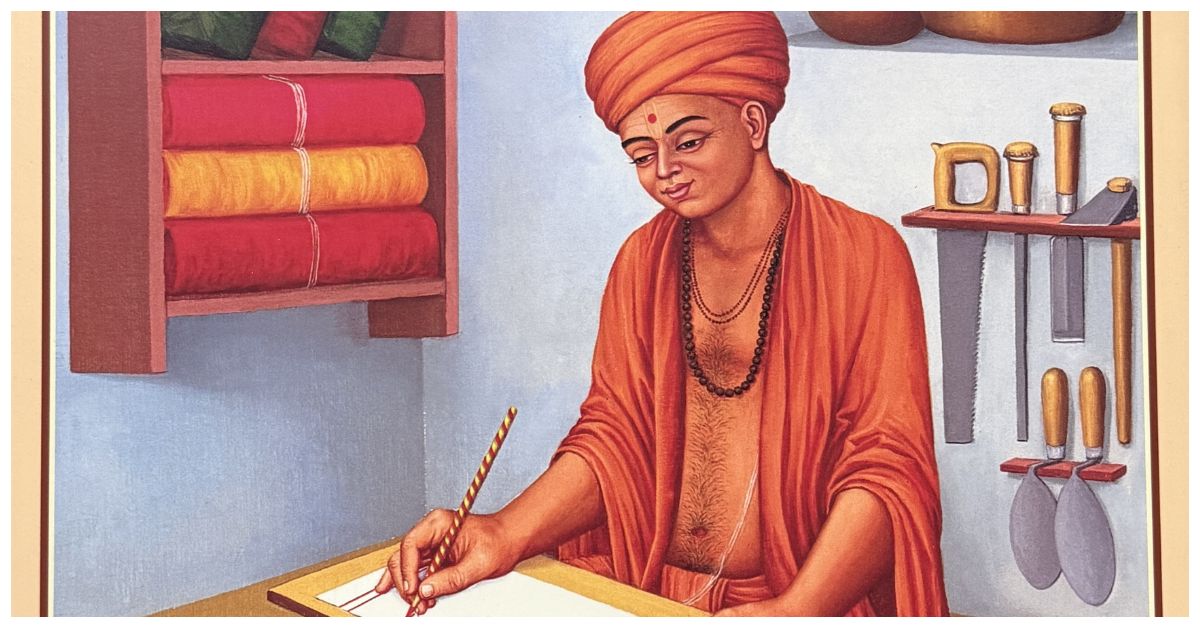
The land of Bhal was dry, but the waters of the rivers of love in the hearts of the devotees were inexhaustible. Darbar Punjabhai had offered as much wealth, land, and property that was needed to build the mandir in Dholera. The innate artistic skill of Vairagya Murti Shree Nishkulanand Swami flourished in all its glory in the construction of Dholera Mandir. Swami was an excellent poet and an equally excellent sculptor. The arch hand-carved by Swami for the temple still attracts everyone’s heart today.
Murti Pratishtha Mahotsav
Residing in Vadtal, Shreeji Maharaj wrote the Shikshapatri on Samvat 1882 (1826 C.E.), Maha Sud 5 (Vasant Panchami). Then, traveling from Vadtal to Ahmedabad, He celebrated the Pushpadolotsav with great pomp and arrived in Kamiyala via Jetalpur. There, devotees like Senso Vanar, Hathibhai, Nathu Gadhvi, Khimrajbhai, Modbhai, and Jijiba gave Him a grand welcome and celebrated the grand festival of Ram Navami. At this gathering, Adbhutanand Swami and other santo from Dholera, along with Darbar Punjabhai and other devotees, came to see Shreeji Maharaj. Maharaj asked everyone for their well-being and also for news about the mandir construction. Then, the santo and haribhakto said:
Adbhutanand ne Punjobhai, kahe sanbhlo jan sukhdai;
Said Adbhutanand Swami and Punjabhai, listen you people (other devotees) who are a cause of joy.
Dholerama je thay chhe dham, thayu taiyar ghanu kharu kam.
The mandir which is being built in Dholera, it is being done with a lot of work still needed.
Mate ap taha have avo, pratimao rudi padhravo; Hashe mandir kai adhuru, dhime dhime karavshu puru.
As such, may you [Shreeji Maharaj] come there and install the murtis of Bhagwan. The mandir may not be fully complete, but it will be completed gradually.
(Harililamrut 8.49)
“Maharaj! The temple work is nearing completion; what remains will be done gradually. But if you come, the auspicious occasion of murti pratishtha can be celebrated”. Shreeji Maharaj immediately told them: “You go to Dholera, and we will arrive there in a day or two. After arriving there, we will decide the auspicious time (muhrat) for the pratishtha”. Because Shreeji Maharaj accepted their prayer, Punjabhai left for Dholera with Adbhutanand Swami and other santo.
Shreeji Maharaj arrived in Dholera on the day of Chaitra Vad 1 V.S. 1882. Punjabhai and other devotees gave Maharaj a heartfelt welcome and procession (Samaiyu). First, Maharaj held Adbhutanand Swami’s hand and went to see the mandir; Nishkulanand Swami was also with them. Maharaj walked all around and saw the mandir completion; He was very pleased. Shreeji Maharaj felt that the santo had poured every ounce of their inner devotion into the construction of this mandir; otherwise, it is difficult to build such a wonderful artistic mandir without resources or money.
Then, Narayan Joshi was called for the muhrat for the murti pratishtha. Narayan Joshi gave the muhrat of Samvat 1882, Vaishakh Sud 13. Because the muhrat was not near, Shreeji Maharaj thought it was not right to stay here for so many days. Shreeji Maharaj said to Darbar Punjabhai and other devotees: “Darbar! We will go to Gadhpur in a day or two and then come two or three days before the pratishtha”. But Punjabhai and other devotees, as well as Atmanand Swami and other santo, insisted that Shreeji Maharaj stay in Dholera and give everyone the joy of His darshan and satsang. Shreeji Maharaj accepted their request.
Evi vinanti suni eh tham, rahya Dhavalpure sukhdham;
Hearing that message at that location, the abode of happiness [Shreeji Maharaj] stayed there at Dholera.
Valti kahyu Vrushkulraje, Dholerana ja mandir kaje.
The king of the descendents of Dharmadev [Shreeji Maharaj] then replied, “For the mandir of Dholera,
Radhakrushnani murtiyo jeh, Gadhpur manhi rakhi chhe teh; Leva mokalo be asvar, suni asvar kidha taiyar.
The murtis of Radha Krishna Bhagwan are kept at Gadhada. Send two men on horseback.” Hearing this the horsemen were promptly readied.
Kahyu murtiyo le zhat avo, Dharmavanshione tedi lavo; Dada khacharne rudi rite, tedi lavo kutumb sahite.
The Lord said to bring the murtis quickly and get the Dharmakul and Dada Khachar’s family as well.
(Harililamrut 8.49)
After a few days, Shreeji Maharaj said to Punjabhai: “The idols of Radha-Krishna for our temple here are kept in Gadhpur, so send two horsemen to Gadhpur. They should arrange the murtis well in a cart and bring them here”. Darbar Punjabhai insisted that the Dharmakul family and Dada Khachar’s family also be present for the pratishtha—and asked Shreeji Maharaj to command so. Seeing Punjabhai’s love, Shreeji Maharaj sent word through the horsemen accordingly. Following Shreeji Maharaj’s agyna, two horsemen immediately left for Gadhpur.
Within a few days, the murtis arrived from Gadhpur. Those murtis were placed in a room there (in the place now known as Akshar Ordi). Shreeji Maharaj came to see the murtis and, stroking them with His hand, said: “The idols are very beautiful and miraculous”.
Along with the horsemen who went to get the murtis , the Dharmakul family and Dada Khachar’s family arrived. Acharya Shree Ayodhyaprasadji Maharaj and Acharya Shree Raghuvirji Maharaj had the darshan of Shreeji Maharaj and performed prostrations (dandvat pranam).
Dekhi raji thaya Dinnath, mukya beyne mastake hath;
Shikshapatriyo be mangavi, api beyne hete bolavi.
Kahyu path tame nitya karjo, ema chhe lakhyu em acharjo; Je je shishya tamara ganay, vartavjo tene saday.
Shreeji Maharaj placed His hands on the heads of both Acharyas and gave each a Shikshapatri, commanding them to recite it daily, act accordingly, and make their followers act accordingly. He gave one Shikshapatri to Dada Khachar as well.
(Harililamrut 8.49)
The time for murti pratishtha approached. Shreeji Maharaj wrote and sent invitation cards (kankotris) to devotees across the region to attend the Dholera mandir murti pratishtha mahotsav. Then, Shreeji Maharaj would sit nearby everyday and watch the temple work near completion. When a few days remained for the muhrat, Shreeji Maharaj called Hariprasad (Haribhai) Sharma from Umreth to perform the murti pratishtha according to Vedic rituals. Many other Brahmins were also called. Ritualistic Brahmins also came and joined in assisting with the Vedic rites. Groups (sanghs) of santo and haribhakto also started arriving from across the country.
The noble Brahmin Hariprasad Sharma prepared the sacrificial pits (yagna kunds) according to scriptural rites. Brahmins were to be seated in the Varuni (ritual selection). Among them, Shreeji Maharaj selected: Nagji Dave of Dholera and his three sons—Virji, Deveshvar, and Ghelabhai; Vasta Raval of the Ganf village, Bhaijibhai, Meghjibhai, Jagabhai, Punjabhai, Nagjibhai, and Gagabhai Vyas; as well as Pandya Nathji Hirji, Odhavji, Purushottam Thakar, both Becharbhai Vyas, Devkrushna and Jagabhai Vyas, Narayanji Shukla, Jagabhai Shukla, Asharam Shukla; and Pandya Laxmiram of Pipali, Keshavji, Mavjibhai, Jani Jivanbhai, Mehta Bhaijibhai; and Jadavji, Harjivan, Jethabhai, Odhavji, Rajaram of Pachham village; Purani Shivshankar of Rojka, Govindram, Travadi Jayshankar, Jagjivan, Gaga Bhatt, Pandya Vastabhai, Raghavji, Bhanjibhai, Becharbhai, Narayanji, Krushnji, Purushottam Mehta; Joshi Krushnji of Khadol, Haribhai, Meghji; Purushottam, Mayaram, Jayshankar, Jadavji of Bhadiyad; Bechar Dave and Bhimji Pandya of Kharad; Rameshvar of Chokadi, Narayan Adhyaru, Nandram Mehta; Jagjivan, Vajeram, Narayan, Purushottam, Damjibhai, Raghavji of Aniyali; Hariram of Zinzhar and Hansraj of Bholad.
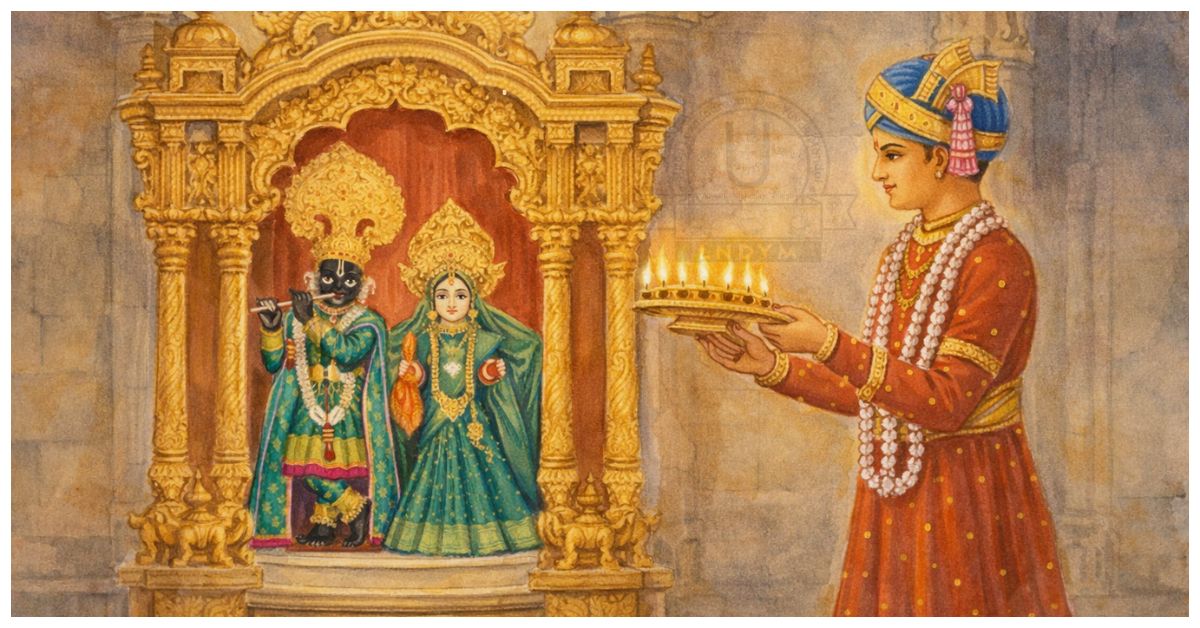
In the same way as Shree Laxminarayan Dev’s pratishtha was performed in Vadtal, the pratishtha of the murtis of Shree Madanmohanji Maharaj was conducted according to Vedic rituals. Exactly according to the muhrat, the idols of Radha and Krishna were installed in the mandir on Vaishakh Sud 13, Samvat 1882 (1826 C.E.). He also installed the murtis of Shree Ganpati and Shree Hanumanji. Shreeji Maharaj personally named the murti of Shree Krishna as ‘Madanmohan’. He Himself also performed the Aarti.
Tema adbhut dekhayu tej, jane Shree Hari pratyaksh e ja;
Within that murti, a wondrous, divine light appeared, as if it was Shree Hari Himself
Aarti Maharaj utari, stuti sante maline uchchari.
Then, the Aarti was performed by Maharaj, while santo performed stuti
(Harililamrut 8.50)
The cool, calm light emitting from Bhagwan Shree Swaminarayan entered the murtis of Madanmohanji Maharaj. Celestial drums (dundubhis) sounded in the sky, and flowers were showered. Gunshots rang out, and the atmosphere echoed with roars. After the Aarti was finished, santo and haribhakto performed prayers (stuti). Devotees of Bhal, including Punjabhai, offered gifts. Giving five hundred rupees, Punja Bapu hoisted the dhvaj (flag), and giving seven hundred rupees, Dosa Sheth hoisted the pinnacle (kalash).
Then Shreeji Maharaj said: “This idol of Madanmohanji is very powerful, and whichever devotee worships it with devotion, all their desires will be fulfilled. Anyone who performs chanting, penance, or vows here in Dholera Dham will overcome the Maya of this world. Just as we have built large temples in Ahmedabad, Bhuj, and Vadtal and made them like Akshardham, in the same way, this Dholera Dham will also be considered a great pilgrimage site. The mahima of this Dholera Dham will increase greatly everywhere”.
Thereafter, Shreeji Maharaj fed the Brahmins and gave them charitable donations and dakshina. Then He also fed all the saints, brahmacharis, parshads, and devotees. The next day, a grand festival of Nrusinh Chaturdashi was held. On the full moon day (Poonam), after breaking the fast in the morning, Shreeji Maharaj sat in the sabha and commanded Adbhutanand Swami and Nishkulanand Swami to complete the remaining work of the mandir. In this way, after completing the mahotsav in Dholera, Shreeji Maharaj went to Gadhpur.
Dholera manhi Dharmakumar, karyo e rite jay jay kar.
In Dholera, the son of Dharmadev hailed shouts of victory
Dhanya Dholerana Harijan, jene arpiya tan man dhan;
Blessed are the devotees of Dholera, who offered their bodies, minds, and wealth [at His feet].
Dhanya dhanya te Dholera dham, kari lila ghani Ghanshyam.
Blessed is the holy place of Dholera, where Ghanshyam performed many divine lilas
(Harililamrut 8.50)
Legacy
The Bhal region was a barren, desolate, and dry area. There was a proverb about Bhal: ‘No hair on the forehead and no trees in Bhal’. A dry province, salty land, little rain, no irrigation facilities. Devotees contemporary to Shreeji Maharaj in Dholera were negligible. Thus, there was even worry about feeding the Thakorji.
But Sadguru Nishkulanand Swami writes:
Jeh dinthi bethi e murati re, teh dinthi thayu sukh ati re.
From the day this murti was installed, there has been immense happiness
She’rma pan thayo samas re, desh-pradeshi vasya kari vas re;
Within the village, a profound sense of harmony took hold; people from various regions came to make it their home
Jiya hata vansadana ghar re, tiya thai haveliyo sundar re.
Where there once stood simple huts, magnificent mansions (havelis) have now risen
Te to Madanmohan pratap re, sahu sukhiya thaya chhe ap re;
This is all the divine and majesty of Shree Madanmohanji; through Him, everyone has naturally become prosperous
Te to jane chhe potana jan re, bijane to manaye nahi man re.
Only His true devotees recognize this divine grace; for others, their minds simply cannot grasp or accept this truth
(Purushottam Prakash Prakar 36, Lines 12-14)
Since Bhagwan Shree Swaminarayan built the mandir in Dholera and installed Shree Madanmohanji Maharaj, there has been abundance and joy in this Bhal region. Due to the travels of santo, the Satsang in this region also flourished. Where there were houses of bamboo, today there are beautiful havelis. All this happiness has occurred due to the power of Shree Madanmohanji Maharaj. Just as a crown rests upon the forehead (Bhal), today this Bhal region has achieved a crowning place in the Swaminarayan Sampraday.