
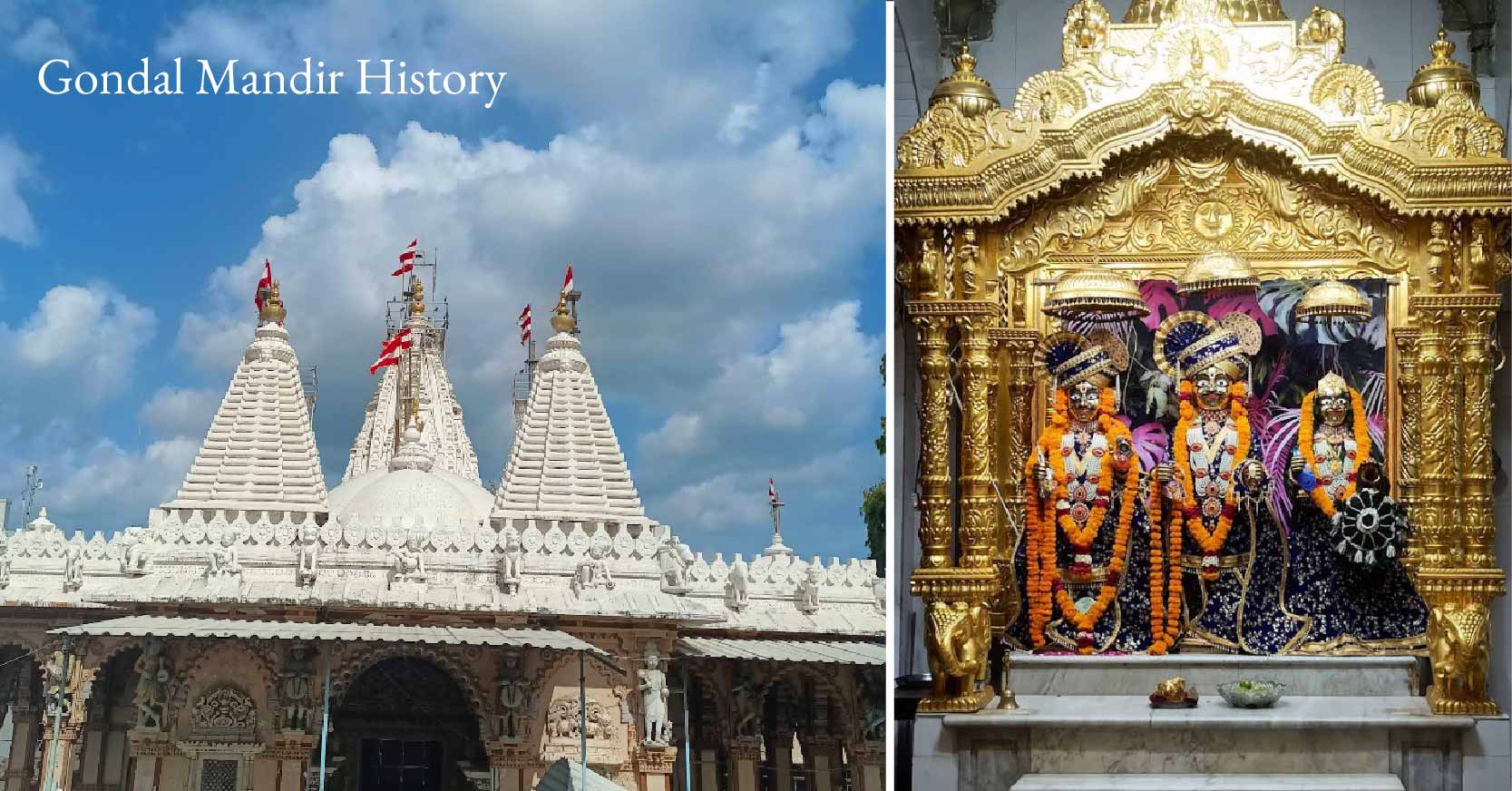

The history of the Gondal and its Royal Family is more than just a timeline of kings and queens; it is a profound chronicle of divine grace, spanning from the time of Bhagwan Shree Swaminarayan to the legendary rule of Maharaja Bhagwatsinhji. Bhagwan Shree Swaminarayan had even performed the divine Shakotsav lila in this village.
A Prophecy Fulfilled
The roots of this lineage began in the humble village of Minapur. It was here that a young girl of only ten years old—who would later become Queen Monghiba—had the rare honor of personally handing the reins of the famous Manki Ghodi to Bhagwan Shree Swaminarayan.

During this brief but divine encounter, Maharaj looked at her and made a powerful prophecy: that one day, she would become a highly esteemed and virtuous Queen. Decades later, as the Queen of Gondal, she would prove those words true through her immense devotion and service to the Sampraday.
The Birth of an Heir
For years, the royal family had prayed for an heir. That prayer was finally answered through the blessings of Sadguru Shree Gunatitanand Swami by the birth of a son in V.S. 1879. In a beautiful gesture of respect, the family asked Swami to name the child. Swami named him “Bhagwatsinhji,” a tribute to the reigning H.H. 1008 Acharya Shree Bhagwatprasadji Maharaj.

Maharaja Bhagwatsinhji grew to be a ruler unlike any other. His most enduring legacy to the Gujarati people is the Bhagvadgomandal—the first-ever comprehensive Gujarati encyclopedia. This monumental work, consisting of nine volumes, took a staggering 26 years to compile and remains the gold standard for the Gujarati language to this day.
The Construction of the Gondal Mandir
Deeply grateful for the divine grace bestowed upon her family, Queen Monghiba wished to offer something eternal back to Bhagwan Shree Swaminarayan. She requested Gunatitanand Swami to oversee the construction of a three-shikhar mandir, which she would fully fund from her personal wealth.
Gunatitanand Swami then travelled to Vadtal inform Acharya Maharajshree of Queen Monghiba’s desire to build a mandir. With the Agyna (command) of Acharya Shree Bhagwatprasadji Maharaj, Sadguru Shree Gunatitanand Swami was appointed as overseeing the mandir construction. Thereafter, Gunatitanand Swami left Vadtal en route to Junagadh before heading back to Gondal.

As this was all unfolding, Gunatitanand Swami had grown very old and he knew he would be withdrawing from the Earth. Once he reached Junagadh Mandir, he entrusted Raghuvircharandasji Swami to look after the mandir while he was in Gondal. He did not, however, reveal that he would be leaving this Earth very soon.
After reaching Gondal with Achintayanand Varni, Krishnasevadasji Swami, and Balmukunddasji Swami, the santo finalized the site and measurements of the mandir.
Shortly thereafter, on the day after Dussehra, Gunatitanand Swami performed his final pravachan, explaining to devotees that the physical body is temporary, and that the atma is immortal, and that they should not grieve his death. It was on this day that he had urged all of the devotees to continue the efforts of building a mandir also appointed Achintayanand Varni to oversee the construction work. Two days later, on Aso Sud 13, V.S. 1923 (1867 C.E.), Gunatitanand Swami returned to Akshardham at the age of 82. Approximately 1 month later, the Khat Muhrat of the mandir took place and construction began.
Murti Pratishtha (V.S. 1928 / 1872 C.E.)
On Maha Sud 13 V.S. 1928 (1872 C.E.), H.H. 1008 Acharya Shree Bhagwatprasadji Maharaj performed the Murti Pratishtha of Shree Harikrishna Maharaj, alongside Dharmadev and Bhaktimata, as well as Shree Radhakrishna Dev.
The Murti Pratishtha Vidhi was officiated by Vipra Shree Haribhai of Umreth, who had also officiated the pratishtha of Shree Laxminarayan Dev in Vadtal. Many esteemed santo from various regions were also present, including Adbhutanand Swami, Shunyatitanand Swami, Pragnanand Swami, Vignananand Swami, Purushanand Swami, Siddhanand Swami, along with the sons of Shree Dada Khachar and others.


The inaugural Aartis were performed by:
- Acharya Shree Bhagwatprasadji Maharaj performed the Aarti for the central shrine of Dharma-Bhakti and Harikrishna Maharaj.
- Prabhuprasadji Maharaj (Acharya Maharaj’s cousin) performed the Aarti for Shree Radhakrishna Dev.
- Bhavi Acharya Shree Viharilalji Maharaj (who would later enthrone the Gadi) performed the Aarti for the Sukh Shaiya.

Upon seeing this divine sight, Queen Monghiba and Prince Bhagwatsinhji were filled with immense joy. Acharya Shree Bhagwatprasadji Maharaj then bestowed his blessings upon everyone present, urging them to celebrate Maha Sud 13 (Patotsav) with even more energy than they would use to celebrate a festival like Diwali. He also praised Achintyanand Varni for his tireless efforts in the mandir construction and for carrying the legacy of Gunatitanand Swami.
Following the pratishtha, Queen Monghiba and the Prince invited the entire Dharmakul Parivar to the palace and performed their pujan. Thereafter, a massive Chorashi was organized to feed all of the Brahmins.
Today, Gondal Mandir stands as a testament to Queen Monghiba’s devotion and the everlasting bond between the Gondal State and the Swaminarayan Sampraday. These events have been documented in great detail by H.H. 1008 Acharya Shree Viharilalji Maharaj in Shree Harililamrut Kalash 1, Vishrams 9 through 12.