
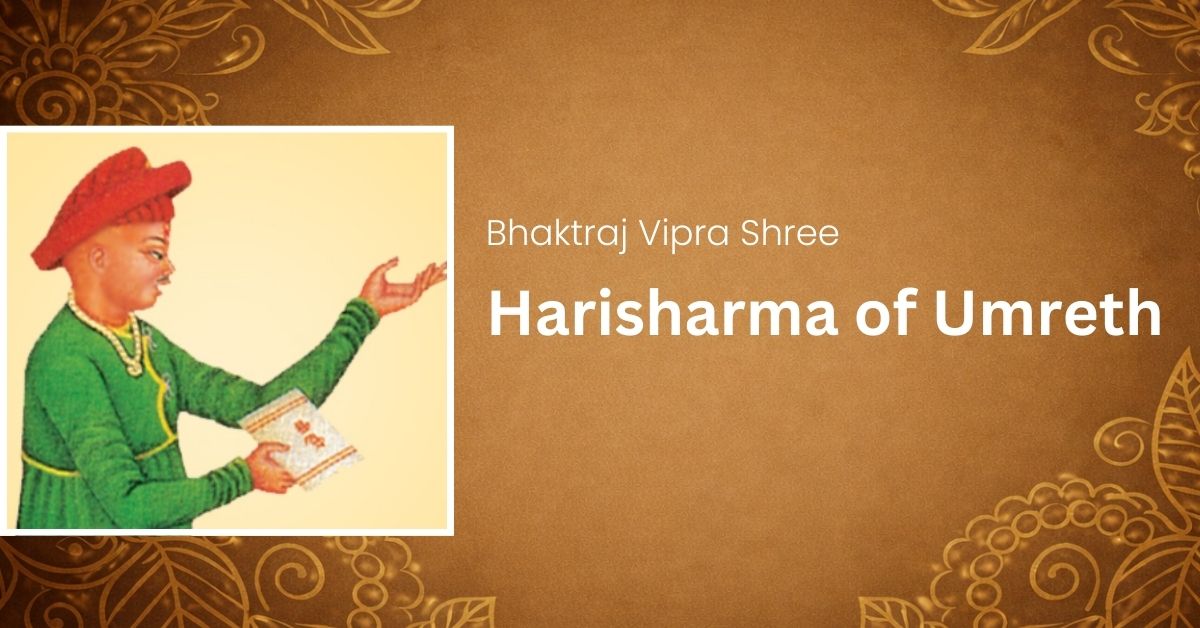

Harisharma was a Brahmin from the village of Umreth. He had been constantly showered with the grace of Maharaj and experienced eternal divine bliss, whose divine aura of profound spirituality are still visible in his lineage today.
His father’s name was Ghelabhai. Harisharma was a pure seeker (mumukshu) with powerful spiritual impressions (sanskaras) from his previous births. From a young age, he practiced devotion toward Bhagwan Shree Swaminarayan while observing tapascharya, vairaya, and niyams. Whenever he encountered sadhus or great souls, he would seek their darshan, serve them, and engage in satsang.
In time, he met Yogiraj Sadguru Shree Gopalanand Swami. Becoming a unique das of that Sadguru, he served him and studied the scriptures under his guidance. Upon receiving Swami’s blessings, even more knowledge blossomed in Harisharma’s life, and he became a Brahmin worthy of Maharaj’s special grace.
Maharaj would have Harisharma determine all the auspicious timings (muhurats) for sacred events according to the science of astrology. Furthermore, Maharaj appointed Harisharma as the chief officiating priest (Mukhya Pujari Bhudev) for the grand yagnas held in Vadtal and Dabhan.
Recording this in the Harililamrut, H.H. 1008 Acharya Shree Viharilalji Maharaj writes:
“Krupashankar je vidvan tenu varun karyu Brahmasthan, Bhala Brahmin je Haribhai kidha Acharya te yagnamai.”
In the Shree Hari Charitra, Akhandanand Varni also writes that when the festival of Jal Jilani was celebrated in Vadtal, Shree Harisharma and Shree Kruparam—both Brahmins—chanted Vedic hymns and rang bells while carrying the vessels of puja materials in their hands.
While few detailed incidents of Harisharma’s life have been recorded, one traditionally heard account is well known:
In the yagna-mandap built in front of Rampratapji Maharaj’s residence, there were eight murtis: Harikrishna Maharaj, Shree Krishna, Radhikaji, Laxmiji, Narayan, Vasudev, Dharmadev, and Bhaktimata. Because these murtis were extremely heavy, the sadhus and haribhakto found it difficult to move them. As the yagna commenced at the hands of Shreeji Maharaj, Harisharma began chanting the Shanti-Sukta mantras. By the divine influence of those mantras chanted by such a holy Brahmin, those eight murtis performed a circumambulation (pradakshina) of Shreeji Maharaj on their own and took their respective seats in the mandir.
Harisharma was candid, guileless, and possessed a gentle nature. When the occasion arose, he would serve the devotees of Bhagwan with great love. Flaws such as worldly attachment, delusion, and ego had been completely uprooted from his heart, and he remained in a state of continuous, natural spiritual knowledge. He served the Sampraday with an innocent and selfless heart and earned the immense rajipo of Bhagwan Shree Swaminarayan. Even today, in his lineage, Shree Bhagwatbhai Shukla along with his brothers provide the Sampraday with the immense seva of conducting murti pratishtha, yagnas, and Mahapuja ceremonies.