
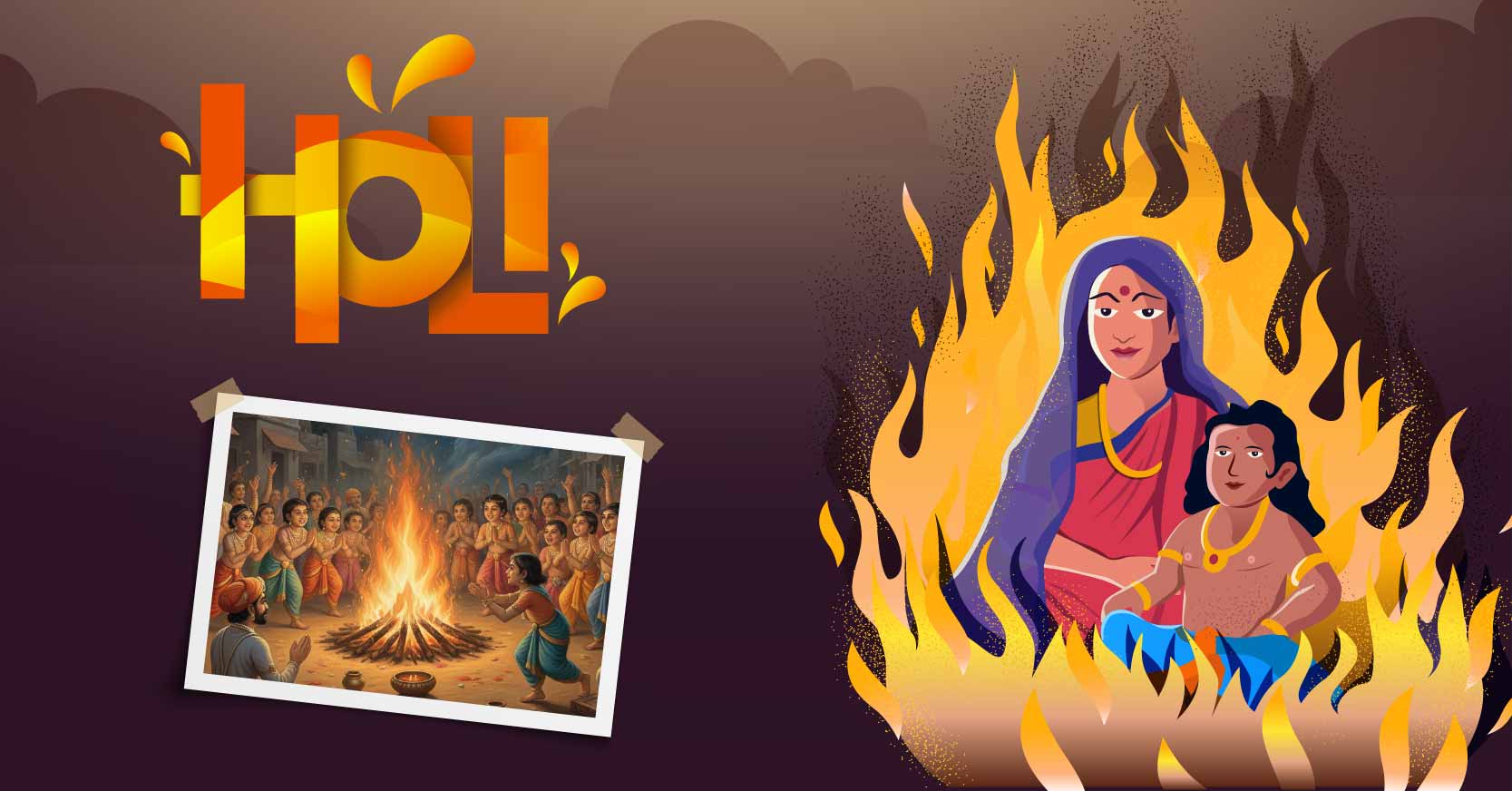

Holi is a Hindu festival that falls on Fagan Sud Poonam. Holi is known as the “festival of colors” and marks the end of winter and the beginning of spring (usually celebrated in March).
In the Bhavishya Puran, Yudhisthir asked Lord Krishna about the festival of Holi. Lord Krishna said that in the kingdom of Raghu Raja, a demon named Dhandha used to kidnap children every evening. The people begged the king to protect them. Raghu Raja did tapasya and found that the demon had the blessing of Lord Shiva and that she cannot die by God or human, with weapon or without weapon. After learning about this, Raghu Raja called a meeting with all of the kingdom’s priests.
They then decided that Fagan Sud Poonam should be a day when the children can laugh and play happily. To accomplish this, they lit a fire and had the children do pradakshina around it along with doing a yagna. This devotion eventually drove the demon away and allowed the children to have fun thus making this a special day for children as well.
The story of Holi is also narrated in Shreemad Bhagwat about the struggles of Bhakt Prahlad against his father, King Hiranyakashyap. Hiranyakashyap wanted everybody in his kingdom to worship only him because he believed himself to be greater than God. Prahlad did not worship his father but instead worshipped Lord Vishnu.
Being disappointed in his son, he ordered his sister Holika to sit with Prahlad on her lap in fire. Holika was given a boon that fire would not hurt her when she wore a special shawl. Since Holika was using her boon for the wrong reasons, a strong gust of wind blew the shawl off of her and onto Prahlad, who was praying to Lord Vishnu, and thus was saved as the shawl landed on him.
Good once again defeated evil. Because of this, Rangotsav was celebrated by devotees because of their love for Prahlad. Therefore, the day after Holi came to be known as “Dhuleti“. On this day in Dwaparyug, Bhagwan Shree Krishna swung the Gopikas on a Hindola made of flowers and played Rangotsav. Thus, this day also became known as “Fuldol Utsav” .