
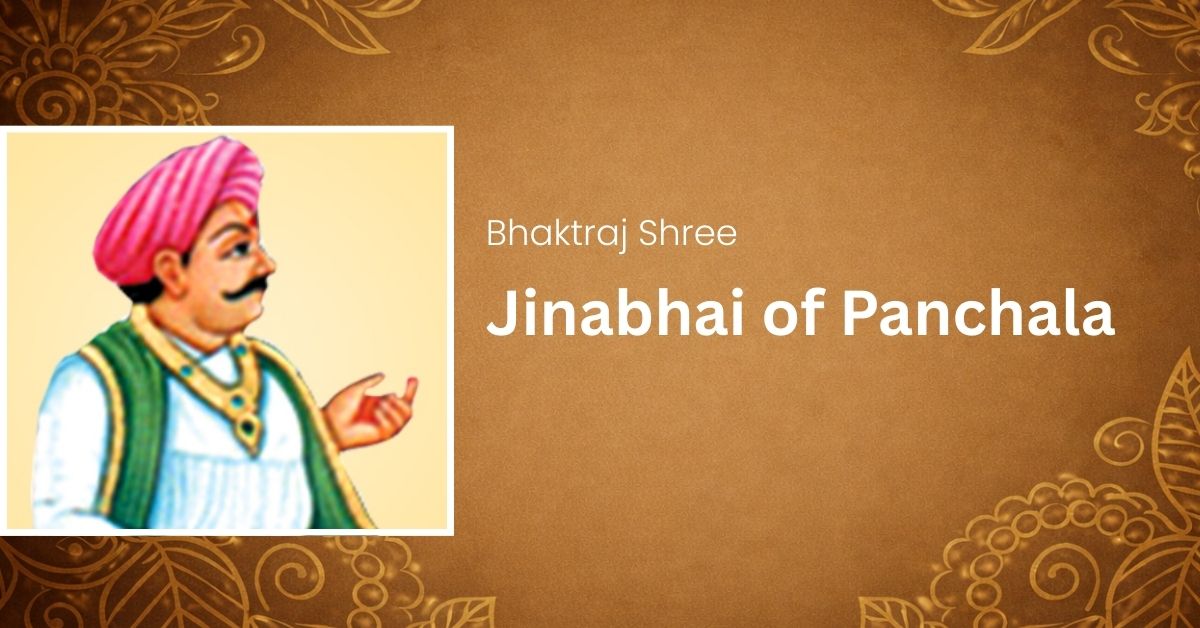

A descendant of the famous ruler of Gujarat, Siddhraj Jaysinh Solanki, and the being the Diwan of Junagadh as well as the landlord of Panchala, Thakore Shree Jinabhai was a unique jewel of the satsang. Today, the sacred land of Panchala remains fragrant with the memory of the Raas Utsav from Fagan Sud Poonam V.S. 1879 (1823 C.E.), the recitation of seven Vachanamruts, and the spirit of Jinabhai’s sharanagati. His family, including his father Manubha Thakore and mother Gangaba, were followers of Shree Ramanand Swami. Consequently, in Shravan of V.S. 1858 (1802 C.E.), when Maharaj arrived in Panchala in the form of Nilkanth Varni alongside Ramanand Swami, that enchanting form was forever etched into Jinabhai’s heart.
In time, he inherited the position of landlord from his father, and due to his inherent wisdom and intellectual brilliance, he became the Diwan of the Junagadh state. Despite this high position, his commitment to satsang never wavered. He frequently invited Maharaj along with the paramhansas. By listening to the profound yet simple discourses of the Vachanamrut, he solidified his spiritual knowledge (gnan). As a result, even the worldly luxuries and festivities of the Nawab’s royal court in Junagadh could not distract him. This led to his reputation in the court as a “man of God,” earning the trust of everyone.
To Jinabhai, Maharaj was millions of times more precious than any kingdom. He had bound his soul to the Almighty. It was for this reason that Maharaj loved staying in a village like Panchala. In V.S. 1879, following the Fuldol festival, Maharaj performed an unprecedented rasotsav at the behest of Bhaktraj Jinabhai. Shreeji Maharaj assumed as many forms as there were sadhus to ensure he played raas with everyone. The divine vibrations of that event still resonate in the blessed soil of Panchala today.
Despite being a wise ruler, Jinabhai valued the satsang and satsangis even more than his own family. Once, when a satsangi devotee named Kamalshi fell ill, Jinabhai’s beloved sister, Adiba, did not provide medicine for his headache, claiming there was very little left. However, when Jinabhai himself fell ill, she brought the medicine out. Jinabhai remarked, “When the devotee of my Ishtadev was ill, you had no medicine, but now that your brother is ill, the medicine has appeared. Go, from today I am not your brother and you are not my sister.”
The history of the Swaminarayan Sampraday notes with pride that when Kamalshi Vanza of Mangrol fell ill, three workers and the fourth being Thakor Shree Jinabhai himself carried him on a cot from Mangrol to Panchala to do his seva. Consequently, Jinabhai attained a fortune and an honor that even Maharaj’s own brother, Ichharamji, did not receive. In V.S. 1883 (1827 C.E.), on Maha Vad 10, when Jinabhai departed from Earth, Bhagwan Shree Swaminarayan Himself—for the only time in His life—gave His shoulder to carry Jinabhai’s funeral bier.