
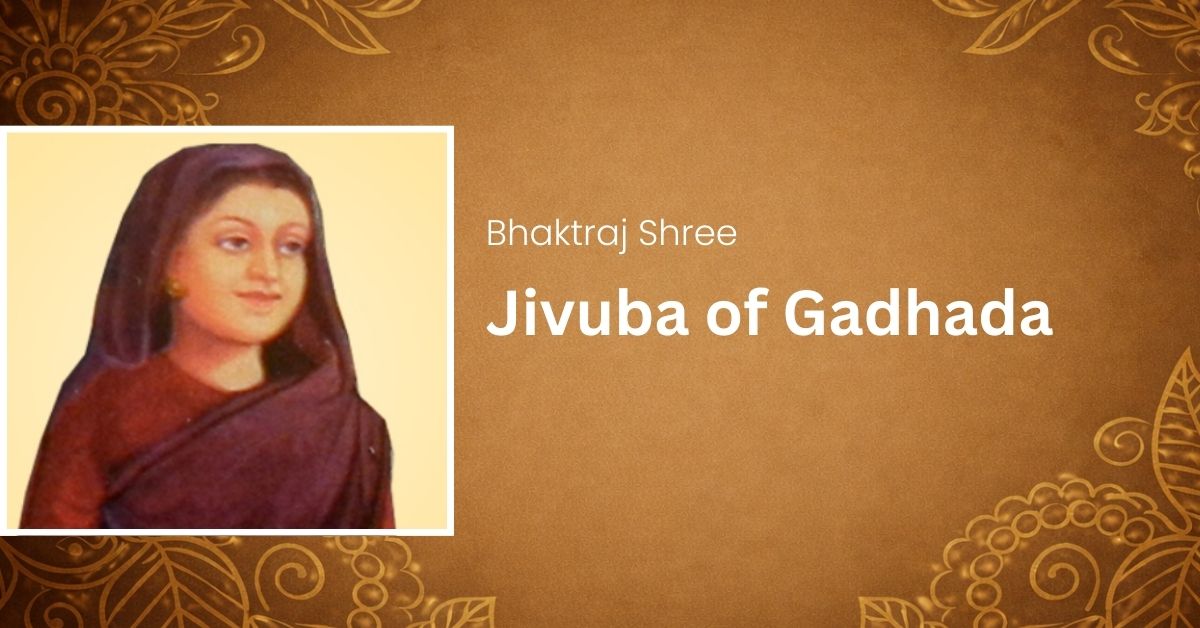

Jivuba was the eldest surviving daughter of Ebhal Bapu. Although Ebhal Bapu had children prior, they did not survive. In V.S. 1841 (1785 C.E.), a child had survived; because this daughter survived, she was named ‘Jivuba.’
From her childhood, Jivuba was virtuous and filled with bhakti. She maintained immense love for the seva of Maharaj. Upon her first darshan of Maharaj, Jivuba became deeply attached to His form and resolved to wed the Lord, attaining the status of Akhand Saubhagyavati (eternally wedded to God). Nevertheless, Ebhal Bapu arranged her traditional marriage to Hathiya Patgar, the Darbar of Kundal. Despite being married, she renounced worldly life and lived a life of austerity and devotion, setting a sublime example for the Sankhyayogi baheno.
In that era, it was extremely difficult for the daughters of Kathi Darbars to refuse to stay at their in-laws’ home after marriage. Yet, Jivuba’s determination remained unshakable. As the fame and glory of Bhagwan Shree Swaminarayan spread everywhere, Ladudanji came to Gadhpur at the behest of Vakhatsinhji to test Maharaj. Ladudanji arrived in Gadhpur with pride in his knowledge, beauty, and intellect to examine Maharaj, but Maharaj, being omniscient, fulfilled all his inner desires and won him over. However, he had not yet renounced his ornaments, silken clothes, or the ego of knowledge filled within his heart. Maharaj devised a wonderful plan. He said to the poet, “Ladudanji, you are a treasury of knowledge. Please explain to these sisters of Dada Khachar that they should remain in the Grahastha (householders) Ashram, so that we are not looked upon unfavorably.”
The poet took it as a simple task; a curtain was placed in the Darbar, and he sat near Jivuba. Ladudanji began his discourse, gradually adding to his discourse the essence of worldly beauty. After listening to everything calmly, Jivuba spoke about the glory of celibacy, the rarity of human life, and the significance of associating with the manifest Supreme Being. Hearing this, the poet’s heart was pierced. Here, poetry was defeated, and the philosophy of bhakti emerged victorious. The poet’s spiritual birth began, and we received the gift of none other than Sadguru Shree Brahmanand Swami.
Jivuba was known in the Sampraday as ‘Motibai.’ Maharaj would praise her virtues such as humility, saintliness, and lack of jealousy, considering her the foremost among women devotees. Jivuba had a generous heart. Through her inspiration, there were approximately one hundred and fifty Sankhyayogi baheno in the Darbar, and Jivuba took full responsibility for the well-being of all these women. In the “Haricharitramrut Sagar,” Adharanand Swami says of Jivuba that her nature was so noble that all the Sankhyayogi women regarded her with Gurubhav. She would speak to the women with such love that they would all enjoy satsang. While speaking, she never spoke of the boundless virtues she possessed; instead, she would celebrate the virtues of other Satsangis.
After Bhagwan Shree Swaminarayan returned to Akshardham, whenever Jivuba had darshan of Gopinathji Maharaj, she would become one with that form, and He would grant her darshan as the manifest Purushottam Narayan. While performing such incomparable bhakti, at the age of 75, Jivuba left Earth for Akshardham on Jeth Sud 6 V.S. 1916 (1860 C.E). At Laxmi Vadi in Gadhpur, near the samadhi sthan of Shreeji Maharaj, stands the memorial shrine (oto) of Jivuba. To maintain the saintliness and purity of this oto, males are not permitted entry. Even today,, women in distress pray to Jivuba at the oto with overflowing hearts, and Jivuba fulfills the wishes of those faithful devotees.