

Once, Bhagwan Shree Swaminarayan began his journey back toward his favorite village, Gadhada. He traveled from Budhej—a place he had made as holy as the ancient village of Gokul—and stopped at the village of Gorad.
There, he visited the home of a chieftain named Kandhoji. To prove his divinity to the skeptical villagers, Shree Hari reminded them of a miracle from years past when he had made the deep waters of their well rise to the brim with a single gesture. Realizing that the “Yogi” they once chased was now standing in their living room, the villagers fell at his feet.
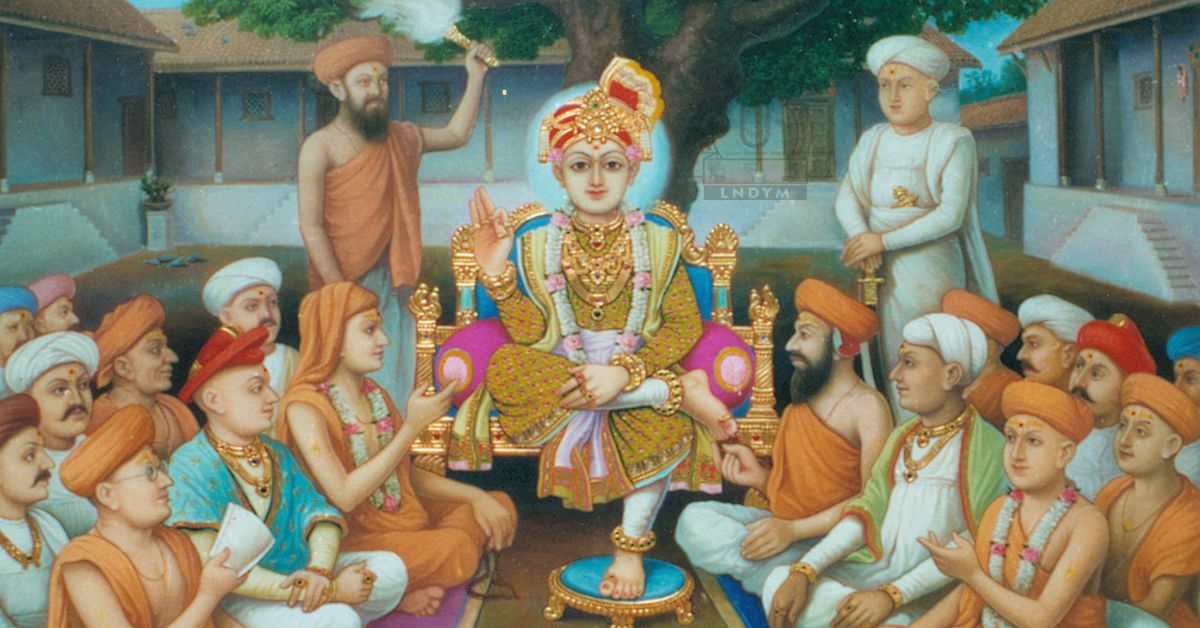
After a long journey through the dusty roads of Gujarat, Shree Hari finally reached the gates of Gadhpur (Gadhada). The village erupted in joy. Santo and haribhakto lined the streets with music and chants of “Victory!” He took his seat in the grand darbar of King Ebhal Khachar, surrounded by his closest disciples including Muktanand Swami, Bhaguji, and Somla Khachar.
The Parable of the King in Disguise
As the evening sabha gathered, Maharaj looked out at the sea of faces and decided to teach them why Bhagwan takes a human form.
“Imagine a Great King,” Maharaj began, “who wanted to truly know his people. He didn’t want to see them through the lens of a throne, where everyone bows out of fear. So, he dressed himself as a poor and ragged person.”
He explained that the King’s ministers also dressed as beggars and went into the villages. The ministers would whisper to the peasants, “Look closely! This beggar is actually your King. If you serve him now, he will reward you with lands; if you mock him, you will face his law.”
Maharaj leaned forward. “Some believed and served the beggar-king with love. Others laughed at him and threw stones. The King said nothing; he simply wrote down every name in his book. When he returned to his palace and sat on his golden throne, he summoned them all. The kind were made lords, and the cruel were cast into dungeons.”
“I am that King,” Maharaj revealed. “I have come in this human form along with my Akshar mukto so that you can meet me without fear. An ant cannot talk to an elephant, and a man cannot talk to a ghost. Bhagwan becomes a man so that humans can find happiness in His company.”
The Parable of the “Hiding” Criminals
The sabha was in awe, but Maharaj wasn’t finished. He saw that some devotees were becoming proud of their own goodness.
“Now, imagine another King,” he said. “He called a meeting and shouted, ‘Any criminal here, stand up and confess!’ A few petty thieves stood up, apologized, and were pardoned. Then the King asked again, ‘Anyone with even a tiny fault, stand up!’ Eventually, every common citizen was standing, admitting they weren’t perfect.”
“But,” Maharaj pointed out, “the high-ranking officials stayed seated. They looked down their noses at the ‘sinners’ standing up. The King turned to them and said, ‘You are the true criminals. You are so arrogant that you hide your faults under your expensive robes.’“
Maharaj looked at his followers. “Do not be like those officials. Do not think that your chanting or your penance makes you better than others, or that you are ‘sinless.’ At every step, a human can falter. Only by shedding your pride and seeking the grace of Bhagwan can you truly be saved.”
Moved by these words, the poet-saint Premanand Swami immediately composed a kirtan: “Me to gunegāra terā re, ho swami ni mera,” an anthem of humility that moved the entire sabha to tears.
This prasang has been documented by Acharya Shree Viharilalji Maharaj in Shree Harililamrut Kalash 6, Vishram 10.