
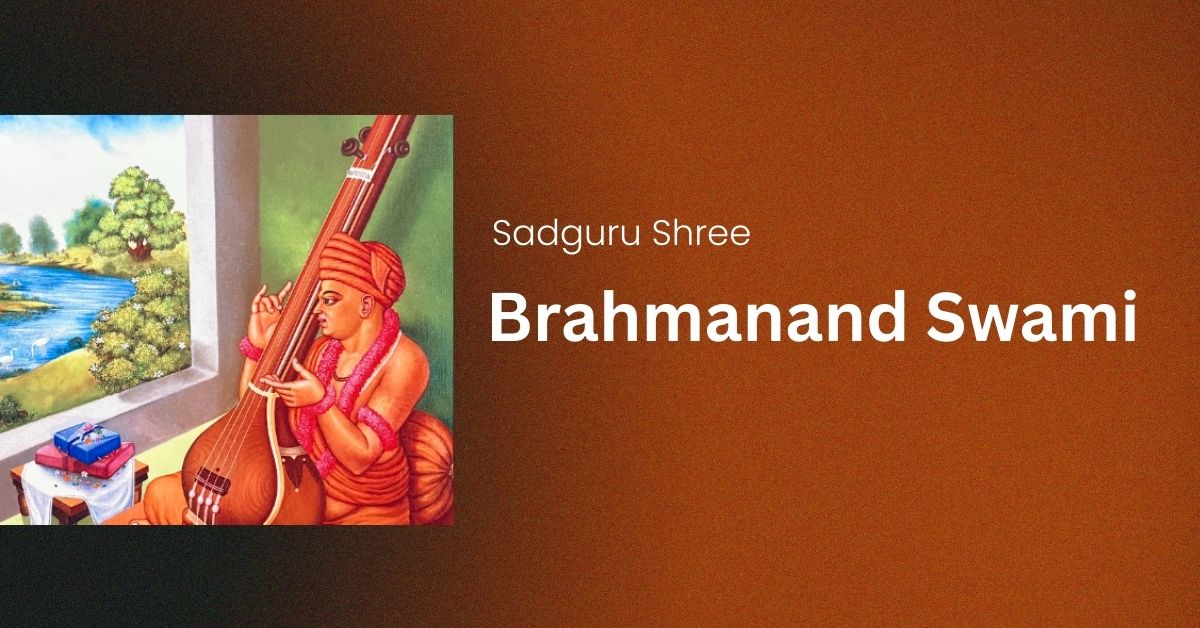

In the village of Muli, by the agyna of Bhagwan Shree Swaminarayan, Sadguru Shree Brahmanand Swami had brought immense joy to everyone by constructing a magnificent shikharbandh mandir along with a royal Haveli. Shree Radhakrishna Dev has brought peace and happiness to the devotees and landowners of Muli.
Before becoming a Sadhu, his name was Ladudanji Gadhvi. He was born on Maha Sud 5 V.S. 1828 (1772 C.E.) in the village of Khan in the Dungarpur region of Rajasthan, located at the foothills of Mount Abu. As he grew up, it became clear from his literary skills that he had the grace of Saraswati Mata. His father, Shambhudanji, was the court poet of Sirohi.
One day, he took young Ladudanji to the royal court. The adolescent Ladudanji presented duhas and chhands (poetic meters) with such brilliance that the delighted king suggested Ladudanji be sent to Kutch to study Dingal and Pingal (classical
Rajasthani poetic languages). Though his parents’ hearts were heavy at the thought of being separated from their son, it was Ladudanji’s destiny to serve at the feet of Bhagwan Shree Swaminarayan and sing His glories. Thus, a Brahmin guest from Kutch took Ladudanji along with him.
Ladudanji’s studies began at the Vraj Pathshala. Under the guidance of Abhaydanji, he effortlessly mastered the arts of Ashtavadhan and Shatavadhan (the ability to attend to eight or a hundred tasks simultaneously). In the quiet of the late night, when Ladudanji would chant the Renki chhand, half the city would awaken from deep sleep just to immerse themselves in his nectar-like voice. After completing his studies, Ladudanji prepared to return to his homeland. When the Maharao of Kutch learned of this, he offered Ladudanji a permanent residence in Kutch, promising him a generous pension (pasawa) and twelve villages as a gift.
Ladudanji replied, “O Maharao, the pain of separation is too difficult for my parents to bear; therefore, staying here is not possible.” Later, Ladudanji pleased the King of Dhrangadhra and received a royal reward of five thousand rupees. Traveling through Jamnagar and Malia, he stunned the Nawab of Junagadh with his poetic ingenuity, earning both rewards and fame. Eventually, he stood before the King of Bhavnagar, where his powerful and flowing oratory left the entire court enthralled.
In the court of Bhavnagar, Ladudanji noticed a tilak of Bhagwan Shree Swaminarayan on the forehead of Nagbhai Soni from Rajula. Ladudanji asked, “To which sect does this mark belong?” The merchant gently replied, “Kaviraj, this belongs to the Swaminarayan Sampraday.” When asked where this new path had emerged from, Nagbhai began to describe the endless divine miracles (parcha) of Bhagwan Shree Swaminarayan. After listening, Ladudanji remarked, “I must go and test the truth of this myself.”
Ladudanji arrived at the court of Dada Khachar in Gadhada. At that time, Bhagwan Shree Swaminarayan was seated on a black blanket, facing east. A garland of fresh roses adorned His neck. Seeing Ladudanji, the Lord placed the flower garland around the poet’s neck. Then, stretching His legs, He asked, “How many divine signs (chihna) are there on my feet? Count them and show me.”
Ladudanji looked closely and beheld sixteen divine signs. At that very moment, he composed and sang a poetic description of all sixteen signs:
કમળ, ધ્વજ, અંકુશ, જવ, વ્રજ, જંબુ ઉર્ધ્વરેખા, અષ્ટકોણ, સ્વસ્તિક નવ, દરિછન પદ ચિહ્નદેખ ગોદ ધનુષ્ય ત્રિકોણ મછ ચંદ્રકળશ નભ સાત ચિહ્ન વામ પદ ચિંતવો પુરુષોત્તમ સાક્ષાત પછીનો
Kamaḷa, dhvaja, aṅkuśa, java, vraja, jambu urdhvarēkhā, aṣṭakōṇa, svastika nava, darichana pada cihnadēkha gōda dhanuṣya trikōṇa macha chandrakaḷaśa nabha sāta chihna vāma pada cintavō puruṣōttama sākṣāta pachīnō
Afterward, Ladudanji remained in Gadhada. Bhagwan Shree Swaminarayan put him through various tests, and having passed them all, Ladudanji emerged as Brahmanand Swami. Brahmanand Swami fulfilled the commands to build shikharbandh temples Vadtal, Junagadh, and Muli. Just as in the aarti how Sadguru Shree Muktanand Swami wrote “Adsath Tirth” (68 pilgrimage sites), Brahmanand Swami constructed 68 pillars in Muli Mandir, where hugging each pillar is the equivalent of visiting each pilgrimage site
While residing Muli, Brahmanand Swami returned to Akshardham in V.S. 1888