
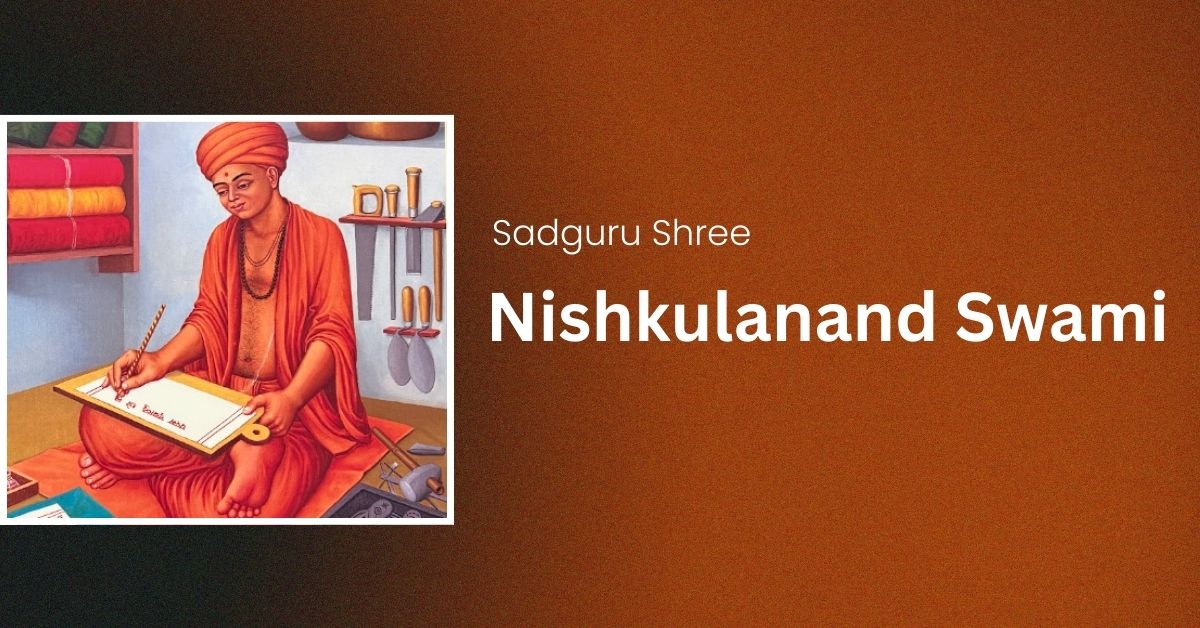

Sadguru Shree Nishkulanand Swami, the personification of detachment (vairagya), held a unique place among the eight prominent poet-saints (ashta kavi) of the Swaminarayan Sampraday. He was not only a pillar of the fellowship but a jewel of Gujarat, a saintly personality whose life was as vast and cool as an ocean.
Swamishree as Lalji Suthar was born on Maha Sud 5 V.S.1822 (1766 C.E.) in the village of Shekhpat, Jamnagar district, to Ramjibhai and Mother Amrutaba. Though he was the head of a prestigious and leading family, he remained detached from worldly life due to a powerful inner surge of renunciation. When he initially requested initiation from Atmanand Swami, he was told to remain as a householder for a while with the promise, “We will call for you when the time is right.”
In Samvat 1860, while traveling toward Kutch, Bhagwan Shree Swaminarayan took Lalji Sutar along as a guide. When they reached Adhoi (Lalji Suthar’s father-in-law’s village), Bhagwan Shree Swaminarayan commanded him to renounce his family ties and initiated him, naming him Nishkulanand Swami. When his wife Kankubai, his sons Madhav and Kanji, and his in-laws came to persuade him to return home, Swami responded by singing his own piercing verses: “Even in my dreams, the world does not please me…” and “I have belonged to the Lord from eternity; all these worldly ties are nothing but burdens.” As a result, his son Madhav also expressed a desire to become a saint. Bhagwan Shree Swaminarayan remarked, “A lion’s offspring is always a lion,” and initiated him as Govindanand Swami.
The unique characteristic of Sadguru Shree Nishkulanand Swami was that, despite having no formal education, he wielded his pen as if it were moved by the divine grace of Bhagwan Shree Swaminarayan, creating extraordinary poetry. The verses of his hymns strike like the edge of a sword against worldly attachments; they pierce the darkness of ignorance and cast the light of spiritual knowledge like a divine eye-salve (anjan). The depth of his intense detachment is vividly reflected in his poems. Even today, listening to his compositions makes the material world seem like mere ash.
Despite being immersed in intense renunciation, he was also a master craftsman of stone and wood. For Fuldol Utsav in Vadtal on Fagan Vad 1 V.S. 1872 (1816 C.E.), he personally crafted a magnificent twelve-door hindolo for Bhagwan Shree Swaminarayan to swing upon, showcasing his expertise in woodwork. Similarly, the intricately carved arches of the Dholera mandir, which Swami carved with his own hands using a chisel, stand as a testament to his mastery of sculpture.
In addition to thousands of kirtans, Swami composed 22 scriptures, which are published as the Nishkulanand Kavya. Among these, Bhaktchintamani is his crowning achievement. On one occasion, after realizing the secret of the supreme divinity of Bhagwan Shree Swaminarayan, he composed the scripture Purushottam Prakash, which also served as the pinnacle of his poetic contributions.
Through his lifelong dedication to writing, Gujarati literature has been continuously enriched. While serving as the Mahant of Dholera mandir, Nishkulanand Swami returned to Akshardham in Samvat 1904 (1848 C.E.).