

Bhagwan Shree Swaminarayan began his day with his usual morning rituals, but the atmosphere was charged with a different energy. His foremost devotee, Dada Khachar, meticulously dressed Him in shimmering silk garments. This was not the attire of a quiet monk, but of a sovereign. Shree Hari buckled a heavy, ornate sword to His waist, slung a quiver of arrows over His shoulder, and took up His bow and shield.
Mounting His famous mare, Manki, He rode toward the assembly grounds surrounded by a sea of horsemen. As He ascended a high, cushioned platform, the sight was breathtaking. To the thousands of armed devotees and saints gathered there, He looked like the very personification of Veer-ras—the spirit of heroism. The air shook with the thunderous “Jay-jay-kar!” of the crowd and the rhythmic beat of massive nagara drums.
The Diplomatic Mission
While the music of the great santo—Muktanand Swami, Brahmanand Swami, and Premanand Swami—filled the air, a shadow approached from the outside. Diwan Baba Saheb, a powerful official, had sent his best military strategist, Mir Saheb, to scout the situation.
When Mir Saheb arrived and looked upon Shree Hari, his warrior’s heart softened. Instead of a rival to be feared, he saw a divine light so radiant that he immediately fell to the ground in prostration. He became a disciple on the spot.
Shree Hari, smiling, gave him a bold message to take back to the Diwan:
“If Baba Saheb wishes to discuss the scriptures, I am ready. If he wishes to fight with weapons, I am ready for that, too. I am fearless.”
The Meeting of Two Worlds
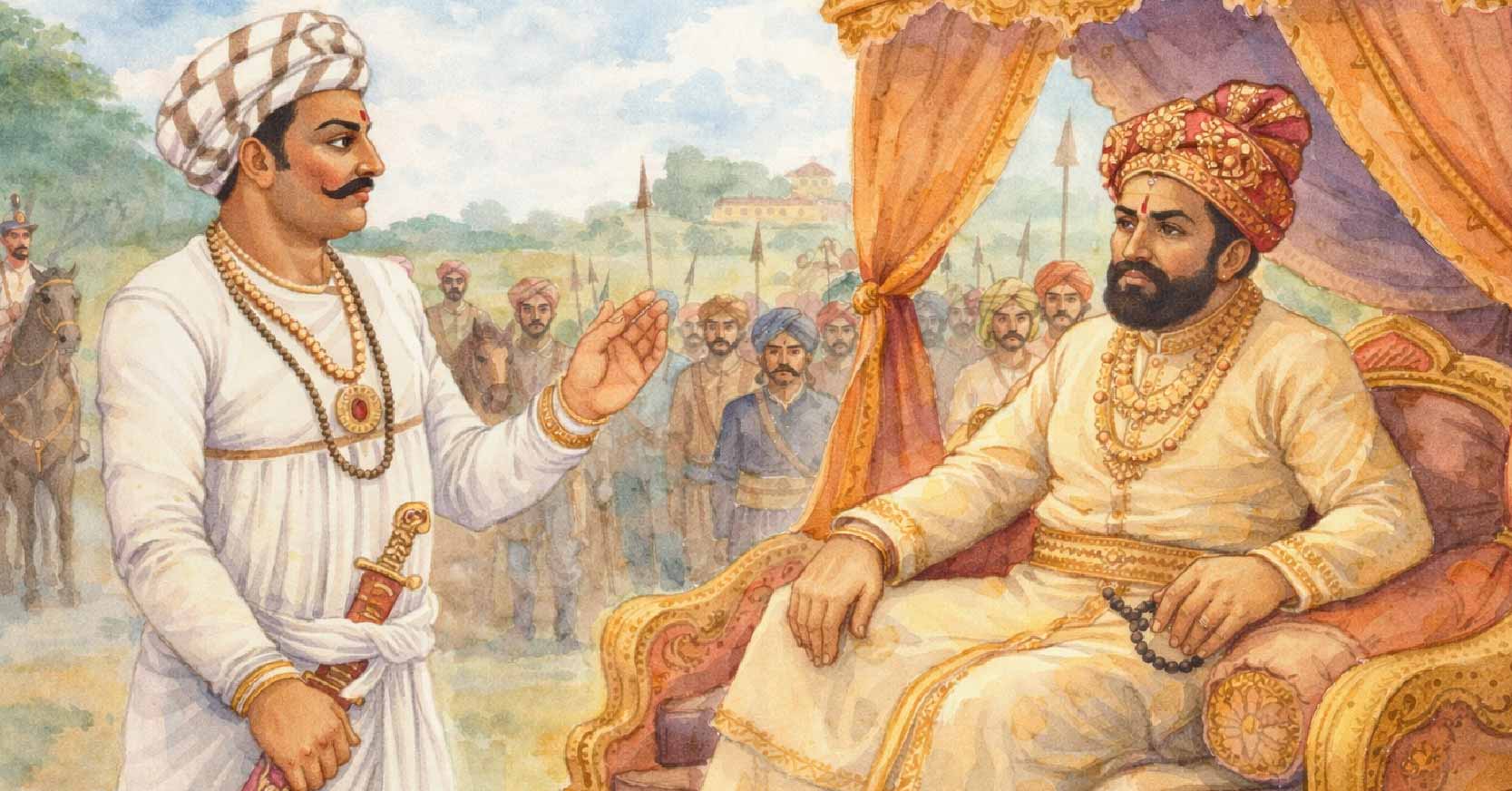
Dada Khachar set out to meet the Diwan near the village of Dudapar. He found the Diwan traveling in a grand palanquin, flanked by thousands of soldiers. When the two leaders met, the tension was palpable, yet they exchanged the traditional courtesies of the time.
Dada Khachar delivered Shree Hari’s ultimatum with a calm, steady voice. The reaction he got, however, was unexpected. The Diwan, despite his massive army, felt a wave of humility—or perhaps a realization of the divine power he was up against.
“Where am I, a mere ant, compared to Bhagwan Shree Swaminarayan?” the Diwan remarked. He swore by Lord Shiva that he had no desire for war, claiming that only “men of evil intellect” spread such rumors. Yet, he was haunted by a sense of spiritual distance, wondering aloud why he felt such a lack of devotion if Bhagwan wasn’t against him. He even quipped, “My well-being would only happen if Swaminarayan made me a Brahmin.”
The Final Retreat
When the Diwan heard the distant, thunderous roar of the crowd from Gadhpur, he grew uneasy. “What is that massive commotion?” he asked.
Dada Khachar explained that it was the sound of thousands of armed devotees surrounding Shree Hari. Mir Saheb arrived shortly after, confirming the sight of the divine and formidable sabha. Realizing that a confrontation would be futile, the Diwan chose to bypass the sabha grounds entirely.
He retreated to a field near the banks of the Unmattaganga (Ghela) River to set up camp. As he moved away, the local townspeople whispered in hushed tones, wondering if the Diwan would eventually lose his nerve or if he would try to capture the noble Dada Khachar.
The day ended not with the clash of steel, but with a “mental defeat” for the Diwan, as the glory of Shree Hari proved more powerful than any army.
The Nature of the Diwan’s Defeat
The Diwan’s reaction at the end of the encounter reveals a man caught between political fear and spiritual pride. When he calls himself a “mere ant” and swears by Lord Shiva that he never intended to fight, it is less an act of true humility and more a tactical retreat; he recognizes that he cannot overcome Shree Hari’s overwhelming divine and military presence. His final quip—asking to be “made a Brahmin”—serves as a defensive shield for his ego. By setting an impossible, miraculous condition for his own devotion, he creates a reason to remain distant. Thus, the “mental defeat” described in this prasang is not a total surrender of the heart, but rather the internal collapse of a powerful man who realizes he has met a force—both worldly and divine—that he can neither intimidate nor ignore.
This prasang has been documented by Aadi Acharya Shree Raghuvirji Maharaj in Chapter 139 of Shree Durgapur Mahatmya.