
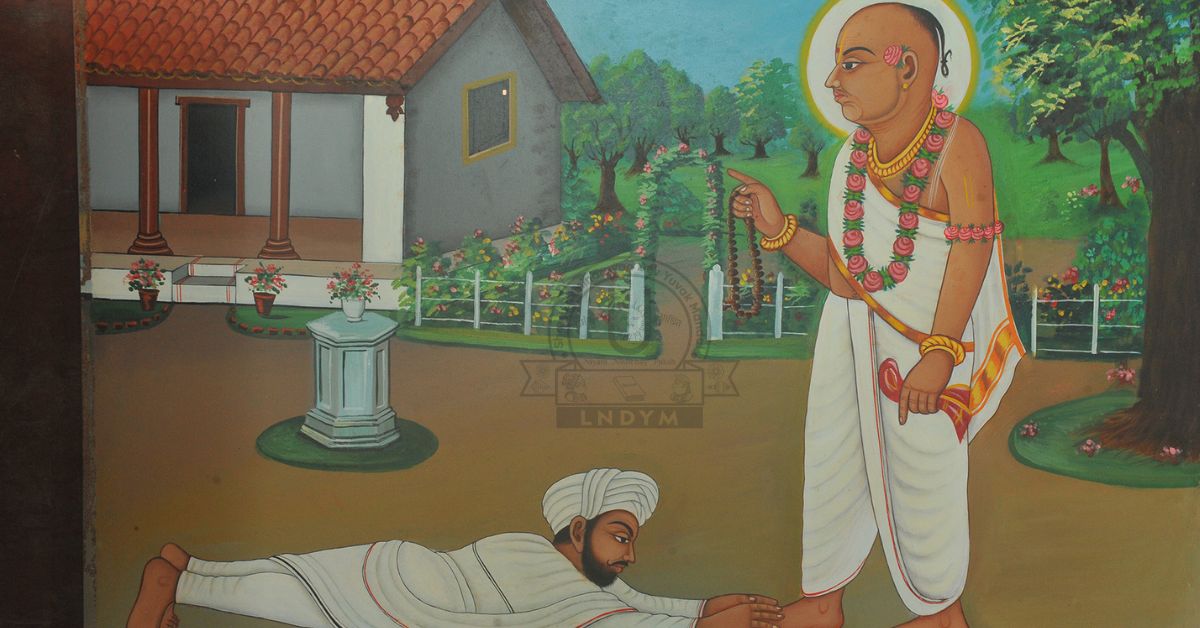

In the village of Bhoyra (near Jasdan), lived two steadfast devotees, Naja Jogiya and Godad Bhakt. They resided within the fort of a fierce and hot-tempered ruler named Vajasur Khachar. One day, the Darbar Vajasur Khachar decided to test their devotion. He commanded them to drink alcohol, a substance strictly forbidden in the Swaminarayan faith.
The devotees refused firmly, stating they would never break the moral codes of their Ishtadev. Enraged, the Darbar issued a terrifying ultimatum: “If your Swaminarayan is truly God, let Him appear here by the day after tomorrow. If He does not come, I will have your ankles crushed with a heavy sledgehammer until they are shattered.” Naja and Godad, placing their lives in Shree Hari’s hands, accepted the challenge. Both bhakto then prayed to Shree Hari that he would come and save them.
Shree Hari’s Rainy Journey
At that time, Shree Hari was in the village of Visnagar. Though it was the monsoon season and rain fell in torrents, He sensed the distress of His devotees. Accompanied by Mukundanand Varni, He set out on foot. They traveled through mud and storms, resting briefly at a stepwell in Adalaj and eating a simple meal of rotlo and vegetables at the village of Makhiyav.
When they reached the banks of the Bhogavo River near Wadhwan, the waters were churning with dangerous waves. Shree Hari crossed the flood as easily as if He were walking on dry land. A shepherd watching from the bank was stunned by this miracle. Shree Hari promised the shepherd moksha if he helped the tired Mukundanand Varni cross the river. Recognizing Shree Hari’s divinity, the shepherd complied, and they continued their journey through the night.
Arrival at Bhoyra
By sunrise, Shree Hari reached Bhoyra. He first visited Naja Jogiya’s house, where He was served a meal of millet bati, leafy vegetables, and sweet yogurt. When Naja and Godad arrived and saw their Ishtadev, they fell at His feet with tears of joy. Shree Hari gently scolded them for entering into such a dangerous dispute, but the devotees replied that they knew their “Ocean of Compassion” would never abandon them.
Pragasun dakshinashayam tadgehebhyo mahipate! | Najabhaktasya veshmani bhrajamanani sanmate! ||1||
Confronting the Cruel King
Shree Hari then climbed the heights of the Bhoyra Fort. On the way to the palace, He saw a horrific sight: prisoners in the dungeons whose ankles and feet had been brutally shattered, screaming in agony. Shree Hari was deeply moved by their suffering.
When He met Vajasur Khachar, the Darbar offered Him a high seat. However, Shree Hari did not mince words. He compared the King to the sinful Ajamila and the tyrant Vena. “You act like a heartless demon,” rebuked Shree Hari. “Breaking the limbs of the innocent and driving nails into the chests of offenders is a sin that will lead you to the darkest hells.”
The King’s Transformation
The King, shaken by Shree Hari’s divine presence and the weight of his own sins, took a blade of grass in his mouth (a sign of total surrender) and fell at Shree Hari’s feet. He explained that he used such cruelty only to control the lawless bandits of his realm.
Shree Hari commanded him to cease all such cruel punishments immediately. The King took a solemn oath that he would never again inflict such pain. He begged for forgiveness, confessing, “I am the lowest of the low; please save me.” Shree Hari then revealed a divine darshan of twelve adityas (solar deities) to the King, which eventually merged into Shree Hari’s own form. Recognizing Shree Hari’s divine status, the King became a humble disciple.
The Grace Conferred
During the encounter, Vajasur Khachar revealed that he suffered from leprosy and asked Shree Hari to cure him. Shree Hari gave him a choice: “If you wish to burn away all your past sins in this one birth, let the disease remain.” The King, now seeking spiritual wealth over physical comfort, agreed. Shree Hari blessed him with the promise of Akshardham at the time of his death.
Before leaving, Shree Hari ensured the safety of His devotees. He placed Naja Jogiya in the care of Dada Khachar and Godad Bhakt in the care of Hammir Khachar.
Some time later in Gadhada, Shree Hari sat on his seat in the veranda at Shree Naga Jogiya’s house. A few devotees were sitting in the front area; looking at them, He said, “This Naja Bhakt is my ‘Ekantik’ devotee. He is of good intellect, patient, brave, and a great hero; he is discerning and an ‘Anadi Mukt’ (eternally liberated soul).”
This prasang has been documented by Aadi Acharya Shree Raghuvirji Maharaj in the 134th Chapter of Shree Durgapur Mahatmya.